The Potty Pad:
Where Should It Actually Go?
When potty training stalls, check the MAP before changing the method. Where the pad sits decides about half the training's difficulty. Our house learned this the hard way: we parked the pad next to the food bowl early on, endured my dog Gureum's quiet strike (it means "cloud" in Korean), and only then studied the science of placement.
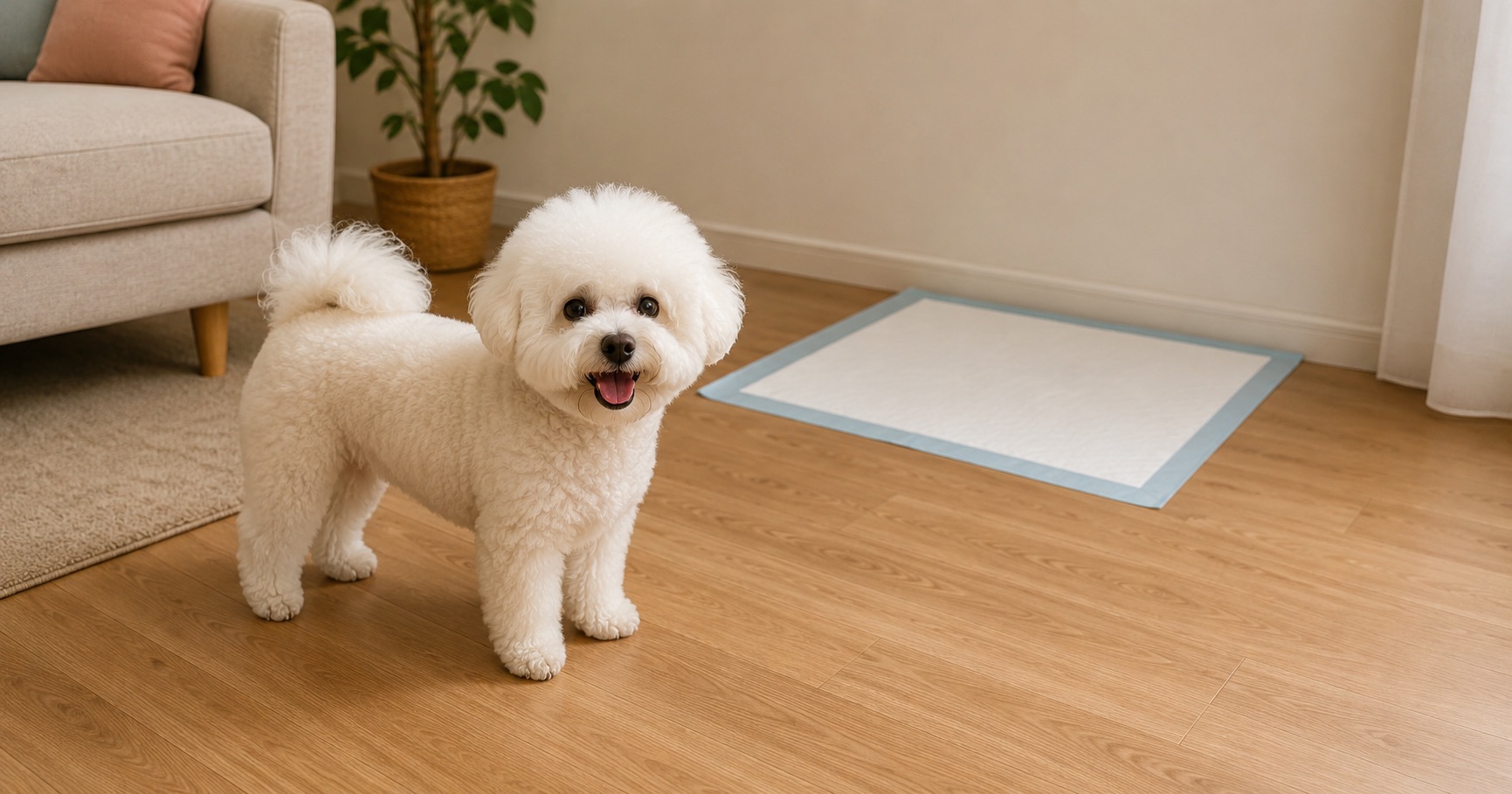
A good location: 1) clearly separated from food and sleeping spots (dogs instinctively avoid pottying near where they eat and sleep), 2) tucked away and quiet but easy to reach, 3) low family traffic: no interruptions, 4) ventilated. The spots to avoid: next to the food bowl, right in front of the crate, mid-entryway, and noise zones like beside the washing machine. And relocations never happen in one move: a foot to three feet per day, slow enough that the dog never notices.
The location checklist
| Condition | Why | Common mistake |
|---|---|---|
| Away from food and bed | The eat-sleep-potty separation instinct | Space-saving next to the bowl |
| Corner + easy access | Pottying in peace | Dead ends behind doors |
| Low traffic | No mid-act interruptions | Center of the living room, hallways |
| No noise | One startle poisons the spot | Beside the washer, the front door |
| Ventilation | Odor management | Sealed corners |
Why bowl-adjacent is the worst spot
Dogs carry an instinct not to soil where they sleep and eat: a den-life inheritance. Park the pad next to the food bowl in a small home and the dog is trapped between the rule (go on the pad) and the instinct (never near the food). The result presents as a mystery: perfect pad, puddle somewhere else. Not a training problem: a floor-plan problem. Put at least several steps: ideally a visual break: between bowl and pad. The day ours moved to the balcony side opposite the food station, the success rate jumped visibly.
The laws of count and size
Early training favors abundance: in a large space, two or three pads raise the base odds of success, then consolidate one at a time toward the final single spot. Size is a variable too: the circler who takes a full lap to settle needs generous real estate, and the near-miss artist (front half on, back half off) does better with two pads joined: widen the target, then shrink it gradually. And cleanliness: a several-times-used pad is, by dog standards, no longer a bathroom. Going on the floor NEXT to a dirty pad isn't the dog's failure: it's a maintenance issue. Shorten the change cycle.
The placement experiment resolves faster on camera
Every relocation changes the success rate. Post the pad's spot and the successes to kkeung: each keeps its date, and which location settled in how many days becomes comparable. Once the spot is chosen: it stays chosen.
Save a photo of today →Relocate like a stroll, not a move
Final destination chosen (balcony, outside the bathroom): now the SPEED decides everything. A foot to three feet per day: frustratingly slow, deliberately. The bathroom coordinates in their head are location memory: teleport the pad and the dog commutes to the old address. Creep it, and the coordinates follow. During the migration, keep the origin spot scent-free with enzymatic cleaner, and sweeten rewards slightly at each new position. If accidents rise mid-journey: hold position two days, then resume.
Placement by floor plan
Studio apartment: real separation distance doesn't exist, so build PSYCHOLOGICAL zones: furniture or a partition breaking the sightline: and favor the entry-side corner over the foot of the bed. Living-room-centered layout: the balcony side or a hallway-end corner are the classic winners: just check the balcony's temperature, since summer heat and winter chill can turn it into avoided territory. Multi-floor or large homes: the pad lives on the dog's MAIN floor: in an urgent moment, a bathroom beyond the stairs is a bathroom too far. And one for later: in the senior years, every floor plan pulls the pad back in close to their daily radius. That courtesy will be due.
Frequently asked questions
Can the pad go in the bathroom?
I removed the pad and they still go on that exact spot.
Is a pad holder (tray) really necessary?
How do I place pads after moving to a new home?
How many pads should I lay out?
This article is general information and does not replace a veterinary diagnosis. Talk to your vet about your dog's condition.