Suddenly Having Accidents?
It's One of These 6 Reasons
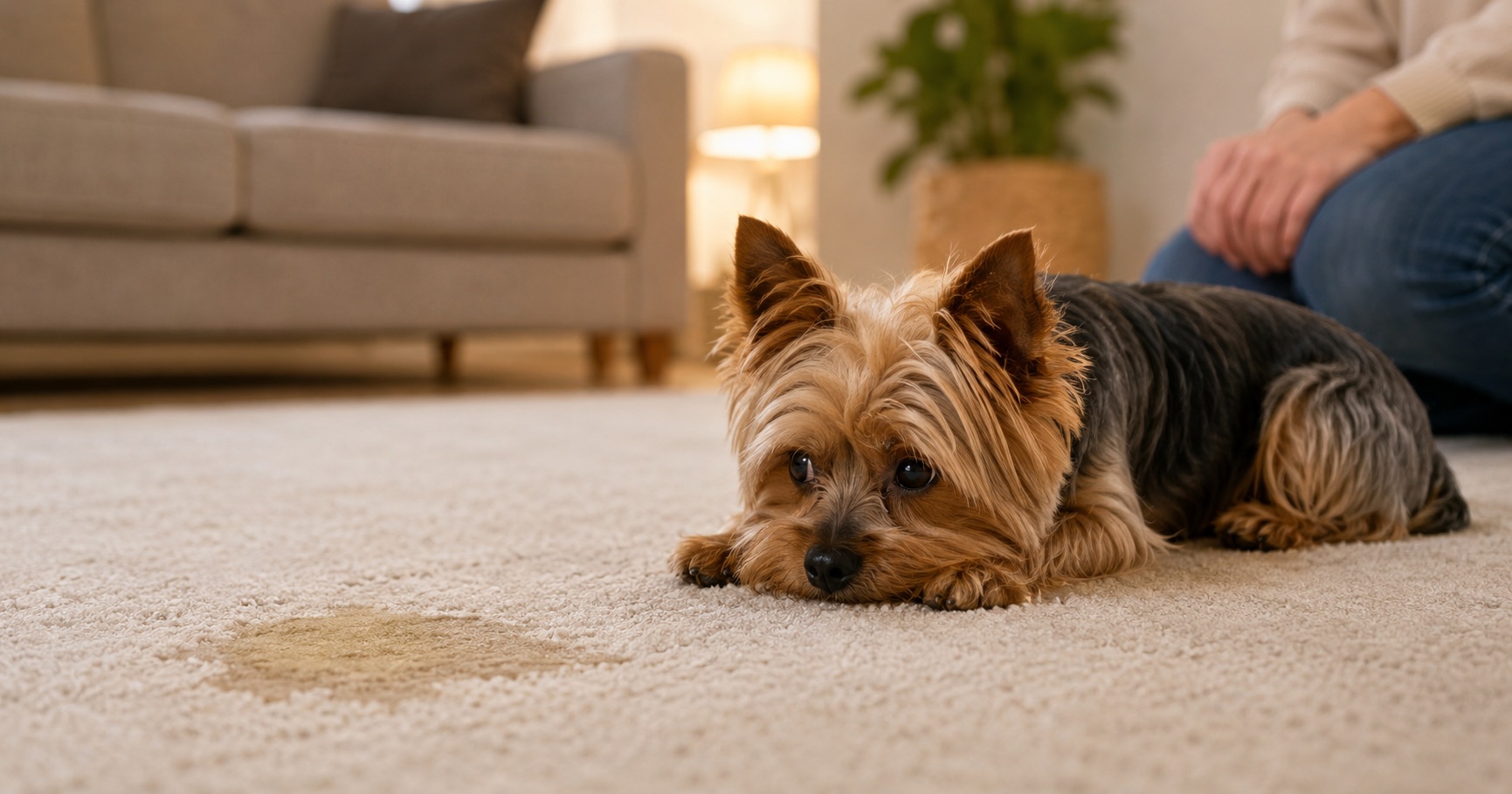
The dog with years of a spotless record leaves a puddle in the middle of the living room, and the owner's head fills with question marks. Why now? Do I scold? The conclusion up front: a suddenly broken potty record ALWAYS has a reason: and half the time, the reason isn't training. It's the body, or the heart.
Six causes cover it. 1) Illness (bladder infection, urinary stones, digestive trouble), 2) environment change (a move, rearranged furniture, a new family member), 3) marking (territory: small amounts, many places), 4) anxiety (separation anxiety, a loud-noise scare), 5) aging (fading bladder control, cognitive changes), 6) pad environment problems (relocation, cleanliness). Above all: a sudden rise in urine accidents rules out a bladder infection FIRST. And scolding helps in none of the six.
The cause-sorting table
| Cause | Clue | Response |
|---|---|---|
| Illness | Urine accidents spiking, dribbles, bloody urine, heavy drinking | Clinic tests first |
| Environment change | Started right after a move, new family, moved furniture | Retraining mode, stabilization |
| Marking | Small amounts, multiple spots, vertical surfaces, new objects | Marking-specific approach |
| Anxiety | Only when alone; after thunder or another event | Manage the anxiety source |
| Aging | Senior dog, leaking in sleep, cognitive changes alongside | Checkup + environment adjustments |
| Pad environment | Right after a location or brand change | Restore, then change gradually |
Why the clinic comes first
The order gets emphasized for a reason. A bladder infection or urinary problem means the dog CANNOT hold it: mistake that for a training problem and the dog is sick AND walking on eggshells. The signals: urination more frequent but smaller: long squats producing dribbles: dark or reddish urine: water intake spiking. Any one of these: urine test first. Behavior causes come after the all-clear: that's the sequence. The week my dog Gureum had back-to-back accidents (it means "cloud" in Korean), I went to the clinic first too: her body was fine, and the culprit turned out to be the pad location I'd changed that same week.
If it's behavioral: retraining mode
Body cleared: it's environment or heart. The common prescription: return briefly to the original training. Shrink the space, escort at the windows, reward the successes: one to two weeks of fundamentals recovers most cases. Layer the cause-specific piece on top: for environment changes, keep their things (bed, toys) in the familiar arrangement to restore footing: for a new family member (a baby, another pet), guarantee a private safe zone and daily one-on-one time. And the accident spots get enzymatic cleaner: down to the last odor molecule: always.
The accident pattern points to the cause
Where and when it repeats IS the clue. Post photos of the spots to kkeung: each keeps its date, showing which day it started and where it clusters. When the vet asks since when: you'll have the exact answer.
Save a photo of today →The absolute don'ts
Dragging them to the spot to scold. The nose-press. The yelling. Every one of the classics backfires. The dog doesn't learn pottying is wrong: they learn getting CAUGHT is wrong: and evolve toward less visible venues: under the bed, behind the couch. Discovery slows, odors set, and the training tangles further. The anger is human and fair: but the moment it transmits to the dog, you've moved away from the solution. Clean quietly, find the cause, fix the system. That's the whole job.
A senior's accidents deserve different treatment
An aging dog's accidents aren't training failure: they're the body changing. Bladder control fades: aching joints stretch the distance to the pad: cognitive shifts can scramble the map itself. The response isn't correction: it's accommodation. More pads, so one is always near: non-slip pathways: more frequent potty opportunities. Recurring leaks during sleep may be incontinence: confirm it at a checkup. And when the dog with a lifetime of perfect records has an accident and lies there deflated: skip the scolding and tell them it's okay. They're just as bewildered as you are.
Frequently asked questions
One accident, fine ever since. Should I worry?
Accidents ever since we moved. How long does this take?
How do I tell marking from a plain accident?
Our first dog started having accidents after the second arrived.
What should I bring to the vet visit?
This article is general information and does not replace a veterinary diagnosis. Talk to your vet about your dog's condition.