When Is a Dog a Senior?
The Start of Aging by Size, and What Changes Now
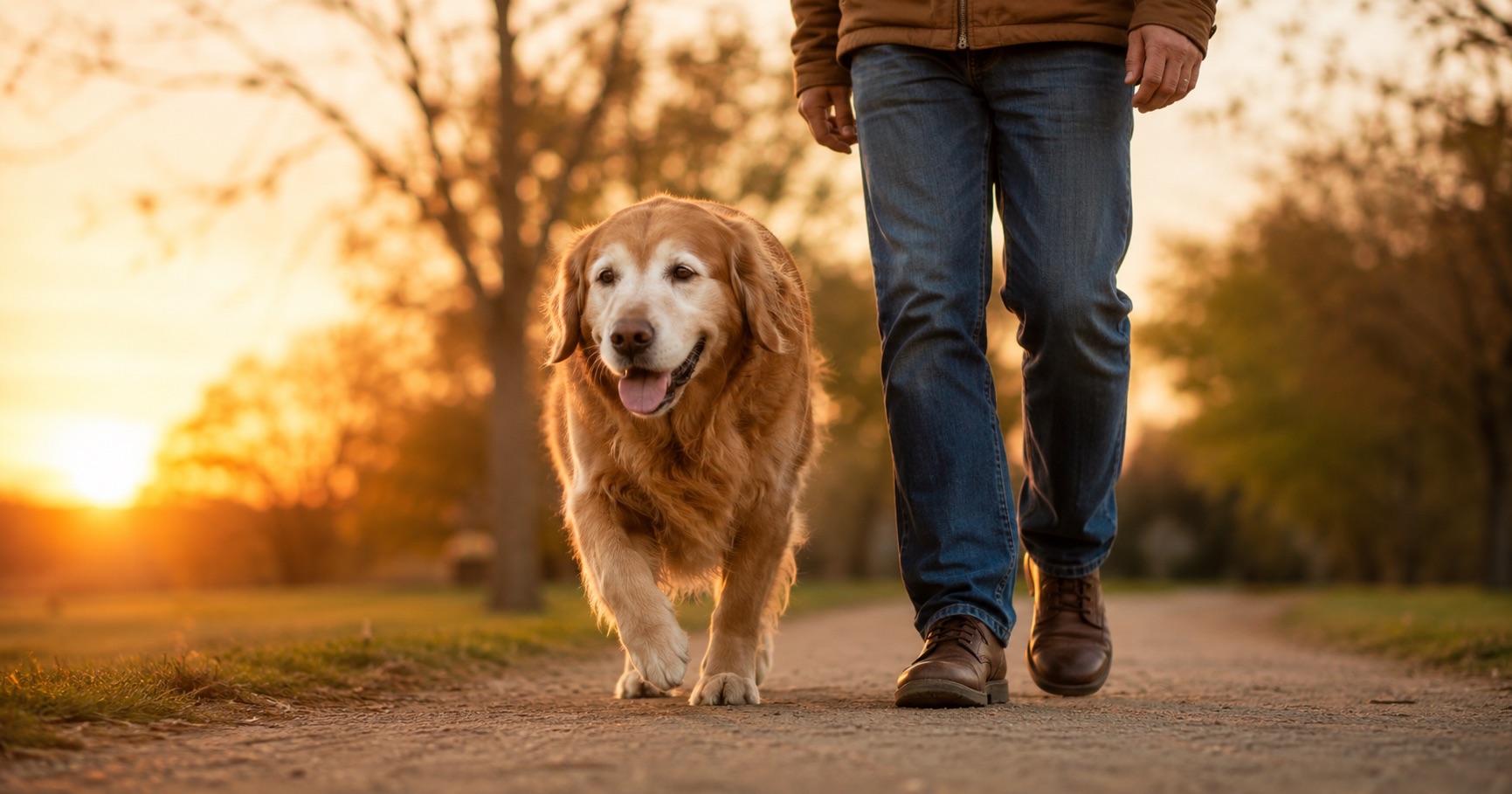
Our walk friend Barley the Golden Retriever's muzzle has quietly gone white. His owner asked the group, "is he a senior now?": and nobody had an answer. Here's the strange truth: a seven-year-old large dog IS a senior. A seven-year-old Chihuahua is in her prime. Why the same age isn't the same age: let's start with the criteria.
Senior status arrives by size: around 10 for small dogs, 9 for mid-size, 7 for large. Bigger bodies age faster. But hear the number right: it's a signal to START MANAGING, not a sentence. At this age, checkups move to twice a year, and food, exercise, and the home environment get age-adjusted. That's the whole assignment.
Why does the threshold move with size?
The bigger the dog, the faster the cells grow: and the faster they age. Lifespan and aging onset both track body size. Converting to human years makes it intuitive:
| Size class | Senior threshold | In human years | Typical lifespan |
|---|---|---|---|
| Toy (under 4 kg / 9 lb) | 10-11 years | ~56-60 | 14-17 years |
| Small (under 10 kg / 22 lb) | Around 10 | ~56 | 12-16 years |
| Medium (10-25 kg / 22-55 lb) | 8-9 years | ~55-60 | 10-14 years |
| Large (over 25 kg / 55 lb) | 6-7 years | ~50-55 | 8-12 years |
※ Breed and individual variation move these numbers within every size class. Your dog's actual changes outrank the table: always.
The aging signs that slip past
- The muzzle and eye areas silver: the most visible flag.
- Sleep stretches longer, and the response to their name lands a beat late: fading hearing, easily misread as selective laziness.
- A brief hesitation at the stairs or the couch: the joints' opening statement.
- The eyes start clouding: age-related lenticular sclerosis is natural, but it needs telling apart from cataracts.
- More sit-down breaks mid-walk.
- Weight creeping up: or muscle melting off until the hindquarters hollow.
- Breath turning serious: most seniors carry periodontal disease.
Learned this watching Barley's family: these signs don't arrive single-file: they slide in overlapping. If one day the thought lands: "has my dog gotten OLD?": that instinct is usually right. My dog Gureum has a new habit of pausing one beat at the stairs (it means "cloud" in Korean): signal or personality, it's written down for the next checkup. That's the practice: notice, note, ask.
Crossing into the senior years: what changes?
Three things first. One: checkups go from annual to twice a year, bloodwork and chest imaging included: senior disease that's visible from the outside is usually disease that's already progressed, making the checkup nearly the only early-detection tool there is. Two: discuss the switch to senior food: the joint-and-kidney-minded design is genuinely different. Three: exercise doesn't SHRINK: it CHANGES. Shorter, more often, flat routes. Stopping entirely melts the muscle: and lost muscle accelerates everything you're trying to slow.
A senior's flex hits different
On the kkeung neighborhood feed, completed walks from the white-muzzled dogs collect a striking number of likes: the whole neighborhood shows up to cheer an old friend's days. Posts keep their dates, so a senior's todays quietly stack into a record worth having.
Show the neighborhood dogs →Doing the senior years well
Guard the weight
Half of senior care is weight held steady: gaining strains the joints and heart: sudden loss is a disease flag. Once a month, same scale, same conditions: watch the trend line, not the single number.
Don't give up on the teeth
The common mistake: postponing dental cleanings out of anesthesia worry: while periodontal disease marches on toward the heart and kidneys. Pre-anesthetic testing prices the risk honestly: doing it while it's DOABLE beats doing it later because there's no choice left.
Keep the brain on payroll
Nose work, a brand-new walking route, one simple new trick: all of it helps hold cognitive function. "Old dogs can't learn new things" is simply false: the tempo slows: the joy of learning doesn't.
If the word "senior" made your chest drop: that drop is just the love, measuring itself. The senior years aren't an ending: they're the opening of the tenderest season there is. And it runs as long, and as comfortably, as the preparation allows.
Frequently asked questions
How do senior years convert to human age?
My senior-age dog is still bouncing off the walls. Start managing anyway?
Do I have to switch to senior food?
At what age does anesthesia become dangerous?
Can a senior dog still get insurance?
This article is general information and does not replace a veterinary diagnosis. Talk to your vet about your dog's condition.