Playing or Fighting?
Role Swaps, and When to Step In
The first time my dog Gureum played with Choco the Poodle, I nearly dove in three separate times: growling, visible teeth, the works (Gureum's name means "cloud" in Korean). Choco's owner just smiled: they're fine: they're trading turns chasing. She was right. Thirty seconds later Choco was chasing Gureum. Here's the rulebook I learned that day.
The play-versus-fight criterion: do the roles swap? Chaser and chased, top dog and bottom dog trading places: voluntary mid-game pauses to catch a breath: big, bouncy, exaggerated movements: that's play. One dog always chasing, the pinned one screaming or fleeing, stiff bodies and short fast strikes: that's a fight. Don't scream into it: separate with leashes or a sharp noise.
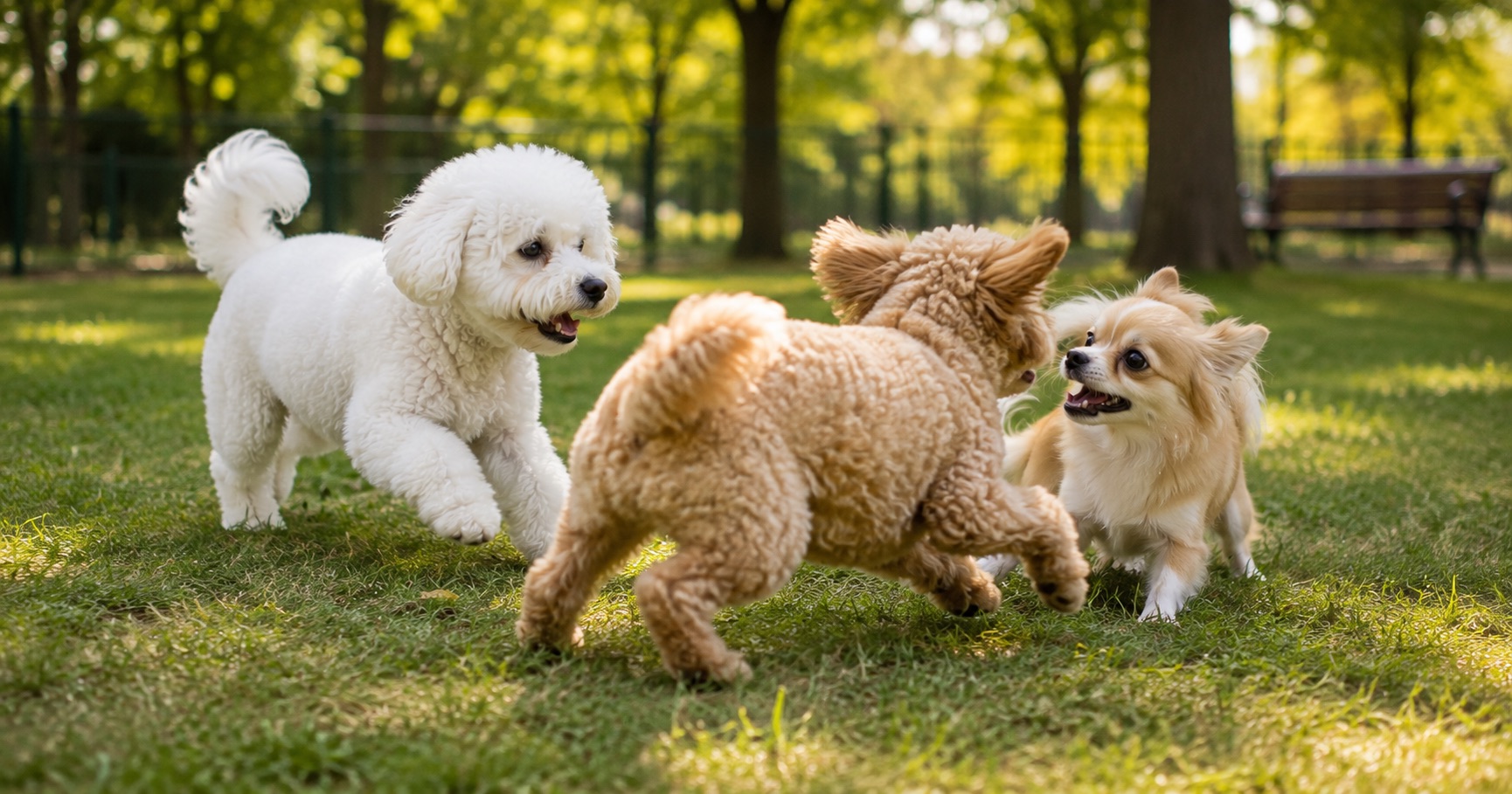
How is play different from fighting?
Dog play is rehearsal for hunting and combat: so of course it LOOKS like the real thing. Growling, biting, mounting, takedowns: all present. What differs is force and rules. Play teeth touch without clamping: the stronger dog loses on purpose: and both stop themselves before the edge. The moment those rules break IS the moment the fight starts.
| Play | Fight | |
|---|---|---|
| Opening | The play bow: front legs dropped | Hard stare, frozen body |
| Roles | Chaser and chased keep swapping | One dog only chases, only mounts |
| Movement | Big, slow, exaggerated, bouncing | Short, fast, straight-line |
| Mouth | Open and loose: inhibited bites | Lips lifted, teeth bared, clamped bites |
| Sound | High, rhythmic growling | Low sustained growling: screams |
| Pauses | Self-interrupts, shake-offs, resumes | No pauses: only escalation |
| The weaker dog | Runs away: comes back for more | Runs away and hides, or glues to their person |
When do you step in?
Any one of five signs: break it up. One: one dog stays on top and the bottom dog can't get out. Two: the pinned dog screams or dribbles urine. Three: bodies stiffen and high tails start a fast quiver. Four: two or more dogs converge on one. Five: a size gap big enough that the large dog's PLAY is dangerous. The principle is to cut it BEFORE these: a fight ignites in seconds, and separating mid-fight is ten times the job.
Learned this on the job: any play streak that runs past 20 seconds without a pause, I call Gureum. She comes: play resumes. She doesn't: session over. Near the arousal ceiling, dogs genuinely cannot stop THEMSELVES. Manufacturing the breathers is the owner's position on the field.
Breaking up a real fight safely
- Hands stay OUT of the neck and head zone: a lit-up dog bites its own person: most human injuries happen exactly here.
- Cut the attention with noise or water: a clap, a water bottle, keys hitting pavement. One second of pause is your opening.
- Leashes on: both owners pull backward simultaneously, opposite directions.
- No leash: lift the HIND legs and wheelbarrow backward. Never the front end.
- Once apart, stay apart: minimum the rest of the day. Then check ears, neck, and armpits for wounds.
The good play partners are a fixed roster
There's always a dog or two with whom play reliably ends well. Friend that dog on kkeung and their completed-walk posts surface in the neighborhood feed: same park, same hour becomes easy to arrange. Two right friends beat ten strangers: safer, and more fun.
Meet the neighborhood dogs →Managing the game, matchup by matchup
The dog whose play always ends in a fight
That's an arousal-throttle problem. Skip the dog park's stimulus flood: start with ONE calm adult, on leash, briefly. Ten seconds of play, a recall, a treat, release to play again. The drill teaches the one thing they're missing: excited AND able to stop.
Big dog, small dog
A large dog mid-play can pin a small one underfoot or pick it up and shake. Allow only the play where the big dog handicaps: flopping over, staying low: and end anything that comes down from above. A small-dog scream ends the session, instantly.
Puppy and adult
An adult growling rules at a puppy is curriculum, not cruelty: sound without tooth contact gets left alone. But a relentless puppy and a visibly weary adult: extract the puppy. Outsource the whole education to the adult and the adult pays for it in stress.
Dog play stops your heart until you know the rules: then it becomes the best show in the park. The deliberate losing, the handicapping, the breathers, the rematch: you realize how much etiquette is running under all that noise. Our only job is the moment the etiquette slips.
Frequently asked questions
Is growling during play okay?
One dog keeps mounting. Is that play?
My dog play-bows and the other dog ignores it. Then what?
One screamed mid-play: but there's no wound.
Are dog parks good for socialization?
This article is general information and does not replace a veterinary diagnosis. Talk to your vet about your dog's condition.