Dog-to-Dog First Greetings:
From the Side, With the Leash Loose
The first meeting between my dog Gureum and Haru the Shiba was a failure: mine (it means "cloud" in Korean). I held the leash short and steered her straight into his face. Haru growled: Gureum hid behind my legs. The second meeting, we just walked the same trail side by side and let the sniffing happen on its own: and they've been friends since that day. The sequence was everything.
The greeting principle: from the side, on a loose leash, kept short. No face-to-face positioning: let them curve in from the side or behind: leash slack, never taut: and break the sniff at three seconds by walking on. Before any of it, ask the other owner: okay to say hi? And if either dog has a high stiff tail and a rigid body: today is a skip day.
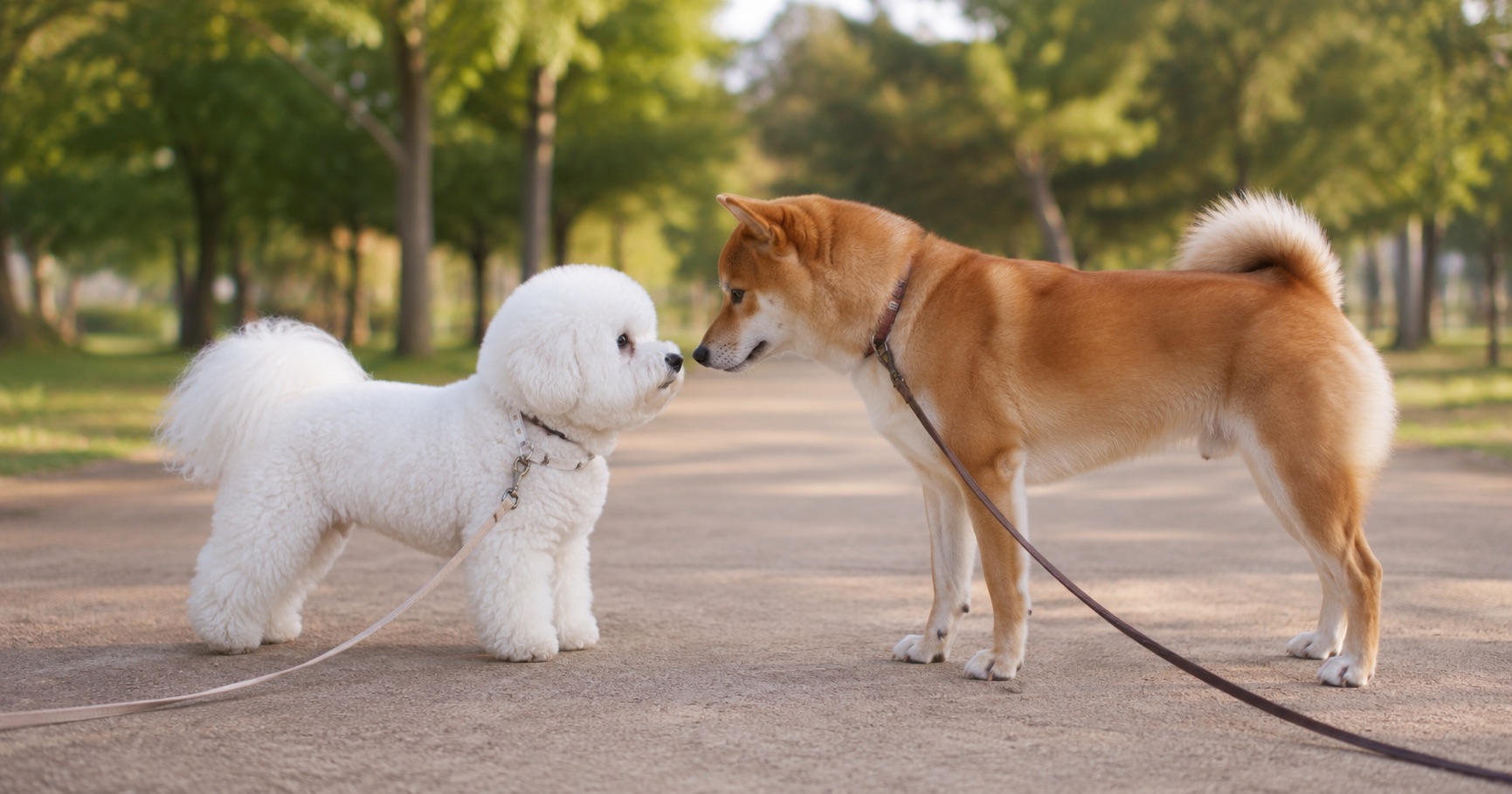
The right sequence
Dog etiquette is human etiquette inverted. We make eye contact and shake hands face-to-face: dogs avert their eyes, curve around, and open with a rear sniff. Squaring two dogs up face-to-face IS a confrontation posture, before anything even happens. And a taut leash tells a dog escape is off the table: which flips them defensive. The sequence below gets most greetings home safely.
| Step | Do this | Because |
|---|---|---|
| 1 | From 30 feet out, ask the other owner | Plenty of dogs don't want greetings |
| 2 | Read both bodies | High stiff tail, frozen posture, hard stare: skip |
| 3 | Walk parallel a few steps, same direction | Kills the head-on approach, drains tension |
| 4 | Leash slack, curve in | A taut leash builds a defensive posture |
| 5 | Three seconds of sniffing, then call away | Longer, and the excitement climbs |
| 6 | Walk parallel again: repeat if all's well | Short and repeated beats long and once |
When should you NOT allow a greeting?
One: both leashes taut, both dogs pulling. Two: either dog with a high flagged tail and weight tipped forward. Three: nowhere to retreat: narrow paths, stairs, elevator doors. Four: the other dog is on a retractable leash: the uncontrolled length is an accident engine. Five: a big size gap: a large dog's play-bounce can injure a small one. Six: your dog is already ramped up from something else. Greetings happen from calm: only from calm.
Learned this on the job: skipping the greeting isn't rude. Honestly, when another owner says first she's a bit on edge today, I'm grateful: Gureum has those days too.
The separate-them-now signals
- One dog's head goes up over the other's neck or shoulders: the opening move of a rank dispute.
- Bodies freeze, tails go high with a short fast quiver: the pre-detonation state.
- One keeps retreating while the other keeps pressing: rescue the retreater.
- A low sustained growl, or a lifted lip showing teeth.
- Sniffing runs past ten seconds and turns into mutual orbiting: leashes tangle, arousal climbs.
To separate: don't yank. Call the name in a bright voice and walk a few steps the other way. A yanked leash stamps the moment as a bad memory: a cheerful exit doesn't.
A good first greeting is how neighborhood friends start
A dog met on the trail is over when the walk ends: a kkeung friend continues. Friend the dog whose greeting went well and you'll trade likes on each other's completed-walk posts: and the neighborhood feed shows who's out today, which makes the NEXT run-in twice as easy.
Meet the neighborhood dogs →Greeting tips, dog by dog
The nervous one
Don't make the greeting the goal. Success is eating a treat at 15 feet while the other dog passes. Shrink the distance gradually, meet ONE calm adult dog repeatedly, and within weeks they close the gap themselves.
The over-exciter
The dog who lunges at first sight earns a rule: sit before any greeting. Can sit: approach. Can't: walk on, no greeting today. A greeting launched at full arousal startles the other dog: and startled is one step from fighting.
The puppy
Puppies launch themselves at every dog alive. Vet the target first: a patient adult, ideally: and when that adult growls, don't panic: that's tuition. But climbing on or biting means immediate removal: and that particular dog comes off the greeting list.
Not every dog needs to befriend every dog: neither do we. An awkward first greeting is fine: a skipped one is fine too. The job is protecting the pace at which your dog is comfortable growing their world.
Frequently asked questions
The other owner says mine is friendly! and keeps coming. What do I say?
Why the butt-sniffing?
My dog rolled over and showed their belly mid-greeting. Okay?
If we skip greetings entirely, does socialization suffer?
An off-leash dog is charging us. What do I do?
This article is general information and does not replace a veterinary diagnosis. Talk to your vet about your dog's condition.