10 Dog Calming Signals:
The Guide to Reading Your Dog's Mind
In our first year, I only knew my dog Gureum was scared when she barked (it means "cloud" in Korean). Then I learned the term calming signals and looked again: before any bark, she'd turned her head, licked her nose, yawned, shaken off: she'd said it ten times. I just hadn't been listening.
Calming signals are the small gestures a dog sends to defuse tension and avoid conflict. The core ten: head turning, nose licking, yawning, shaking off, moving slowly, sitting or lying down, turning away, sudden sniffing, soft blinking, and approaching in a curve. See one: stop what's happening, or add distance. Ignore them, and the next chapter is growling and barking: the one after that is teeth.
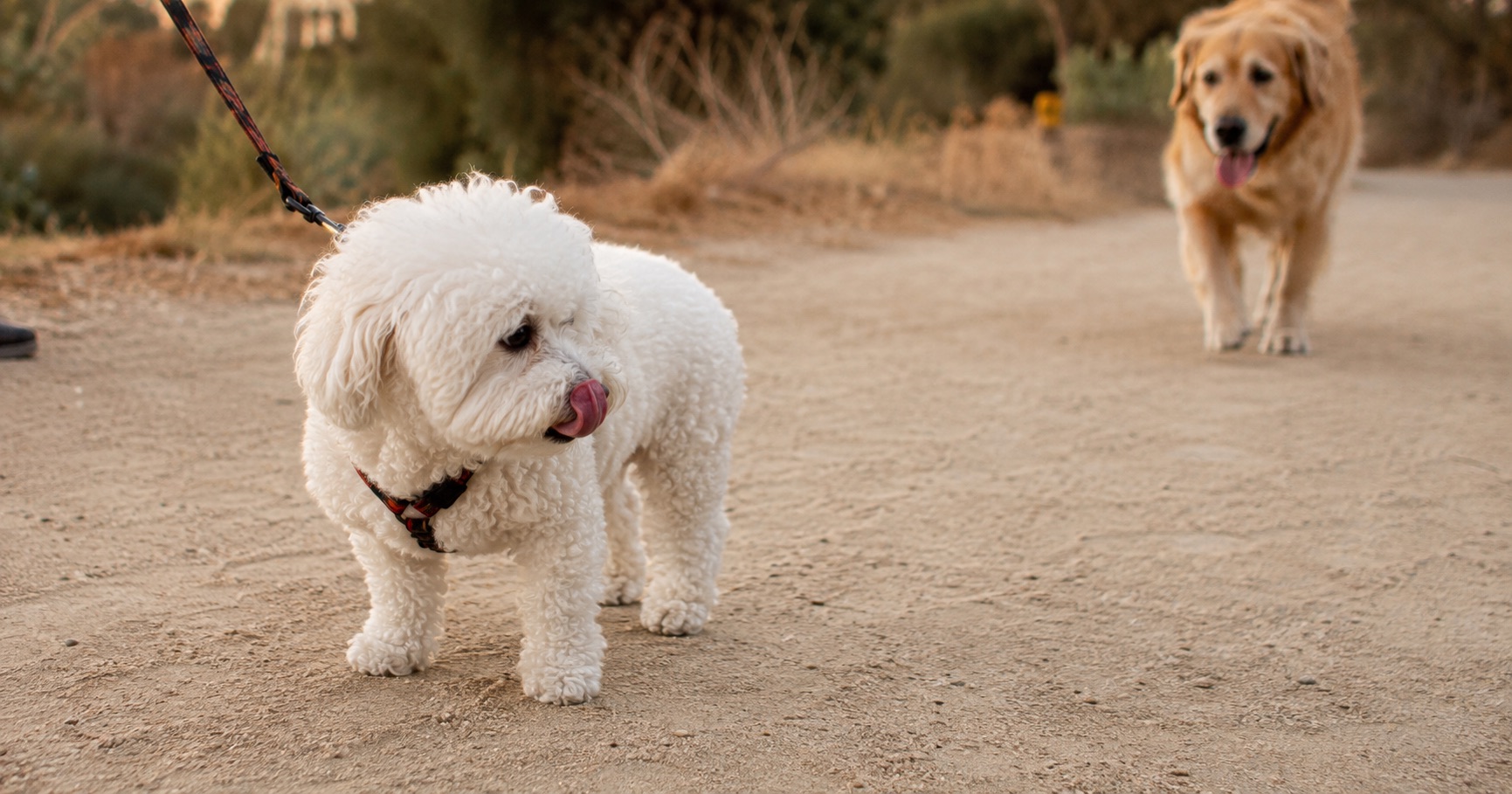
The ten signals
The concept comes from a Norwegian trainer's long observation of wolves and dogs. Dogs use these signals constantly to negotiate with each other and skip the fight: humans mostly can't read them. The ten below are the most common. One alone can be coincidence: two or three in sequence is a message.
| # | Signal | What it looks like | Typical situation |
|---|---|---|---|
| 1 | Head turn | Face and gaze swing sideways | Someone approaching head-on |
| 2 | Nose lick | Tongue flicks the nose tip | Cameras, guests, the vet |
| 3 | Yawn | Short, and nowhere near naptime | Being scolded, being hugged |
| 4 | Shake-off | The full-body shake, bone dry | Right after a tense moment ends |
| 5 | Slow motion | Movements decelerate, hesitate | An angry owner |
| 6 | Sitting, lying down | Sudden drop in posture | An overexcited dog incoming |
| 7 | Turning away | Presents their side or back | Play running too hot |
| 8 | Sniffing | Nose abruptly dives to the ground | A strange dog appears |
| 9 | Soft blinking | Slow, repeated blinks | Direct eye contact |
| 10 | Curved approach | An arc instead of a straight line | Meeting a new dog |
You saw a signal. Now what?
One move: stop the current thing, or grow the distance. The reaching hand pauses: the camera lowers: the leash loosens and the route bends: the scolding voice drops. Answer the signal and the dog learns that talking WORKS: the messages get smaller and earlier. Ignore it repeatedly and they abandon the quiet vocabulary: straight to growling, then straight to teeth. A large share of he bit without warning stories are precisely this: years of warnings, unheard.
Learned this on the job: when Gureum suddenly buried her nose in the ground mid-walk, I used to tug her along. Now I look UP instead: eight times out of ten, another dog is coming down the path. She was telling THAT dog: I'm no trouble. The conversation was never with me.
Can you send signals back?
Yes: and they work surprisingly well. Approaching a scared dog: curve, body angled sideways, no direct stare, slow blinks. Facing an overexcited one: sit down, or turn your back: the temperature drops fast. Even the yawn transmits: one big slow yawn instead of a reprimand, and you can watch the body unclench: that person isn't looking for a fight. And note: the standard human greeting: straight in, hand extended, eye contact: is politeness in our grammar and provocation in theirs.
Heavy-signal days end in short walks
Days thick with calming signals tend to be the days the walk cuts short and turns for home. Log walks in kkeung and the distance and time stack by date: the unusually short day stands out at a glance. A shortened walk is itself one of the signals.
Log today's walk →Reading practice, by situation
When guests visit
Guest reaches out: your dog turns their head and licks their nose: translate out loud: not quite yet. Have the guest sit and look away: the dog will come sniff on their own schedule. THAT'S the green light for petting.
When kids play with the dog
A child hugs or climbs on: the dog yawns and goes stiff: that's endurance, not enjoyment. Miss it and the next signal is a growl: dangerous for the child. An adult translating in real time is the actual safety equipment.
When the camera comes out
Lens up: nose lick, head turn: to a dog, a lens is one enormous eye. Shoot from the side with the camera low, treat after every shutter: the signals thin out within weeks.
Dogs were never quiet: we just only counted the barking as speech. On today's walk, count the head turns. That number is how many things your dog said to you: today alone.
Frequently asked questions
Are calming signals the same as stress signals?
My dog ignores other dogs' signals and charges in. Why?
Is all ground-sniffing a calming signal?
My dog avoids my eyes after doing something bad. Guilt?
Why is shaking off a calming signal?
This article is general information and does not replace a veterinary diagnosis. Talk to your vet about your dog's condition.