Does Your Dog Know When You're Sad?
Emotional Contagion, and the Signals Dogs Read
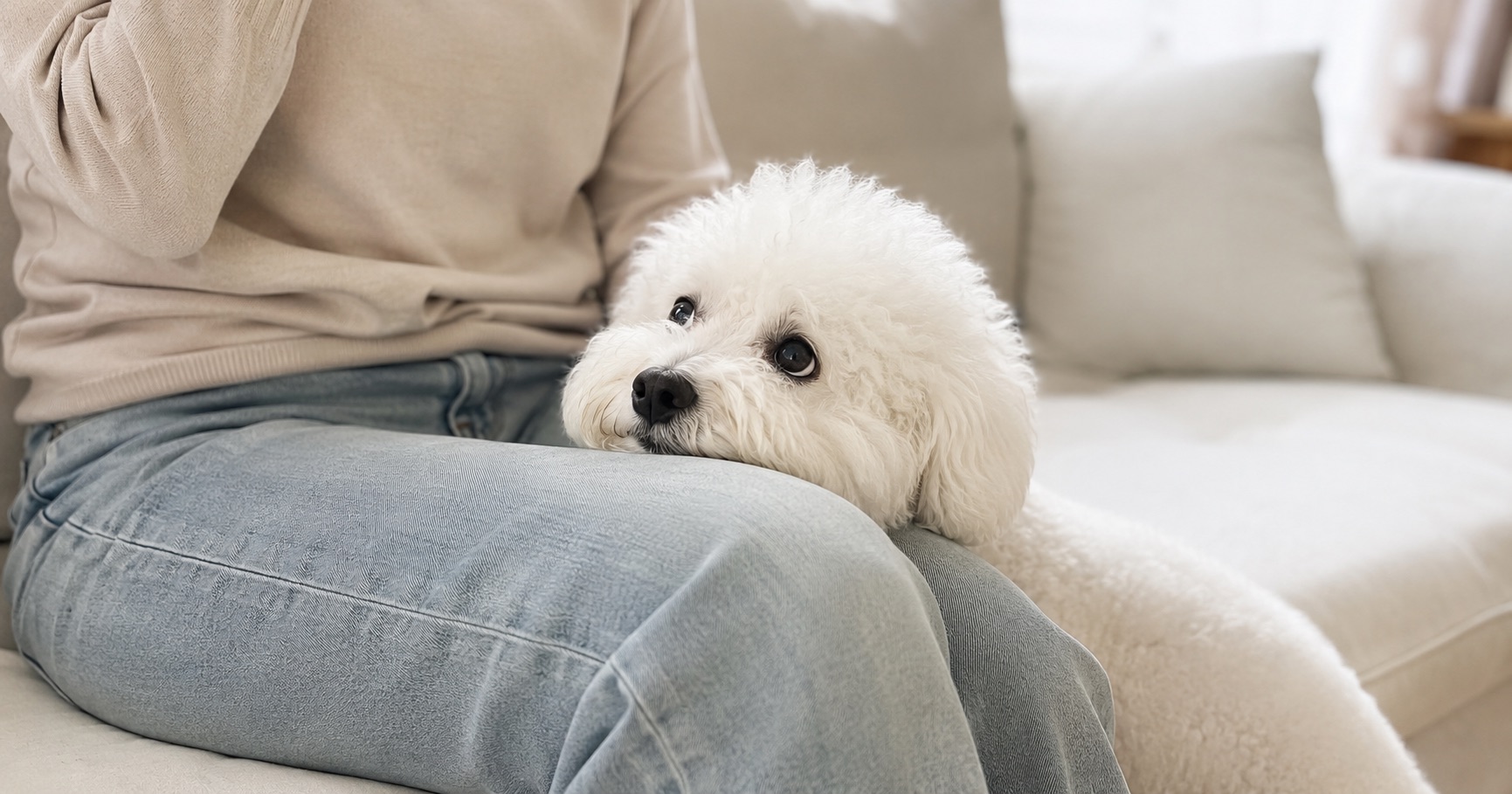
On one particularly heavy evening, my dog Gureum skipped her usual play campaign, came over, and rested her chin on my knee (it means "cloud" in Korean). I hadn't said a word. Too consistent to be coincidence: she did it on exactly those days. Does she actually know? I went looking. Here's what I found.
Yes: they know. Dogs read your emotions through your face, your voice, and your scent. Research shows dogs approaching the sound of human crying, and dogs' heart rates rising at the smell of stressed-human sweat. The catch: the emotion TRANSFERS. When an owner struggles for a long stretch, the dog's stress hormones climb alongside. Which is why, in the hard seasons, the walk routine protects you both.
How do dogs read human emotion?
There's research showing dogs look at the LEFT side of a human face first: where human emotion shows more strongly: which is, notably, what humans do with each other too. The voice: brain-imaging work found regions of the dog brain responding specifically to the emotional tone of human speech. And the scent: stress changes the chemistry of human sweat and breath, and dogs can tell the difference: in experiments they distinguished sweat samples from stressed versus relaxed people with high accuracy.
| Channel | How | What research confirmed |
|---|---|---|
| Face | The left side: eyes and mouth shape | Distinguishing angry from happy photos |
| Voice | Pitch, tremor, pace | Approaching and touching at crying: not at humming |
| Scent | Chemical shifts in sweat and breath | Dog heart rate rising at stress-sweat |
| Behavior change | Broken routines, reduced movement | Dog activity shifting with the owner's |
| Hormonal sync | Long-term cohabitation | Owner and dog stress hormones moving together |
Does your mood transfer to your dog?
It does: the term is emotional contagion. A study measuring stress hormones in owners' and dogs' hair over months found the two levels rising and falling TOGETHER: and the more worry-prone the owner's personality, the higher the dog's numbers ran. The dog's own personality barely mattered. The direction of travel: dog follows human. So if, in a low season, your dog seems flat, has more accidents, or licks their paws constantly: that may be your state, arrived in them. Not said to add guilt. Said because it means caring for the dog IS caring for yourself: the same act, twice over.
Learned this on the job: in my own worst stretch, Gureum wouldn't leave my side: and licked at her own paws constantly. I didn't see it then: that licking was her version of the anxiety. My weather had reached her.
What do dogs do for a sad person?
Come close and simply stay: lick a hand or a face, slowly: chin on the knee: an unusual quietness. In one experiment, dogs hearing crying through a door pushed it open and went to the person: and interestingly, the FASTER a dog went in, the LOWER its own stress response measured. The overwhelmed dogs froze at the threshold. So if your dog is sitting quietly against you right now: they're worried, and being calm about it, on purpose, for you.
On the hard days, one paw stamp protects two lives
In many households, the owner's hardest months show fewer walks: and those same months show more paw-licking from the dog. Log walks in kkeung and the distance and time stack by date, making that connection visible. On a heavy day, ten minutes around the block: that one stamp lifts both of you at once.
Log today's walk →Protecting each other through a rough patch
Keep the routine: even the minimum version
When meal times and walk times wobble, the dog's anxiety rises first. The walk can shrink: ten minutes, one lap of the block. The routine HOLDING is itself the message: the world is still okay. And that ten minutes hands you sunlight and steps you wouldn't otherwise have taken.
It's okay to cry in front of them
Don't spend energy hiding it: the scent already told them. When they come, receive them: pet them and breathe slowly. That human stress hormones drop while petting a dog is one of the best-established findings there is.
Watch for your weather in them
More paw-licking, potty accidents, appetite shifts, night pacing: those can be your state, transferred. When they appear, the first fix is often not dog training but the owner getting support. If the hard season has run past a few weeks, tell someone: a professional, or a person you trust. For the dog's sake too, if that's the reason that finally works.
The day Gureum put her chin on my knee, I got up because of her and we walked. A dog can't treat what hurts: but they can be the reason you stand up. Some days that's enough. If today is one of those days: start with the leash.
Frequently asked questions
Can dogs get depressed?
Is my dog approaching me when I cry an attempt to comfort me?
Why does my dog avoid my eyes when I'm angry?
If I'm anxious, will my dog become an anxious dog?
Does having a dog actually help with low moods?
This article is general information and does not replace a veterinary diagnosis. Talk to your vet about your dog's condition.