Why Your Dog Follows You Everywhere:
Attachment or Separation Anxiety?
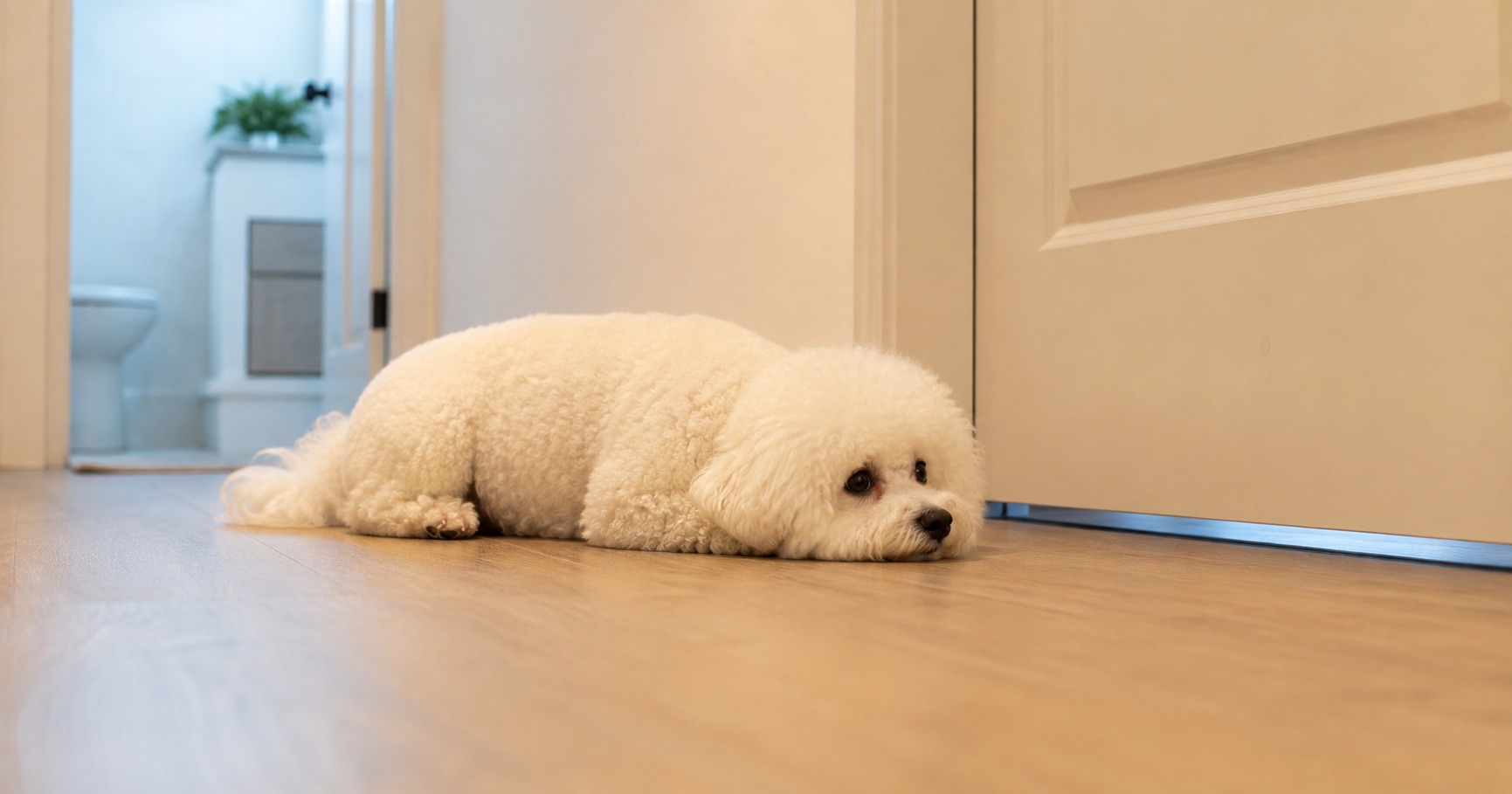
My dog Gureum lies down outside the bathroom door when I'm in there (it means "cloud" in Korean). Kitchen: kitchen threshold. Balcony: pressed to the glass. At first it felt like being adored. Then one day the question arrived: is this because she loves me: or because she's afraid I'll disappear? The two look identical on the outside. Inside, they're opposites.
Dogs follow for five reasons: attachment, curiosity, requests, habit, or anxiety. Follows you, flops down comfortably nearby, and returns to their own business when you leave: healthy attachment. Whines and paces the moment you're out of sight, scratches doors, starts trembling at the sight of your coat: that's the anxiety side. The test isn't whether they follow. It's what happens when they CAN'T.
Why do dogs follow at all?
Dogs are pack animals: staying near the pack's core member IS the default. Then learning stacks on top: that person moving means something's coming. Kitchen equals snacks, front door equals walk, couch equals petting. Following has always paid out. The complication: whether the foundation under it is attachment or anxiety flips the correct response completely.
| Reason | What it looks like | When you disappear | Response |
|---|---|---|---|
| Attachment | Follows, then settles comfortably nearby | Watches a moment, returns to their business | Leave it be: it's healthy |
| Curiosity | Comes to see what you're doing | Loses interest, wanders off | Leave it be |
| Request | Staring, whining, paw on your leg | Tries another family member | Brief pause before granting |
| Habit | Drifts after you on autopilot | No particular reaction | Build them a resting spot of their own |
| Anxiety | Glued to you: agitated at any gap | Whining, door-scratching, pacing, panting | Alone-time practice: consult if severe |
Attachment or anxiety: the three-part test
Check three scenes. One: you enter another room and close the door. Attachment waits outside and falls asleep: anxiety whines and scratches. Two: your pre-departure ritual. Panting, trembling, and shadowing at the sound of keys or the sight of a coat: anxiety signals. Three: home-alone behavior. Sustained barking, potty accidents, destruction: that confirms it. Two or more of the three: treat it as separation anxiety and start the practice.
Learned this on the job: Gureum lies at the door when I vanish: and about five minutes in, starts snoring. Verdict: attachment. Meanwhile Bean, the Pomeranian we walk with, reportedly scratches the bathroom door until his nails wear down: his owner can't shower in peace. Same behavior at the door: entirely different problem behind it.
When the following is too much
- Stop paying out every follow. If the kitchen dispenses a treat every time they trail you in, the kitchen becomes mandatory.
- Make alone-time profitable: leaving for another room, drop a snuffle mat or long-lasting chew on their bed first.
- Praise the stay: the moment they DIDN'T follow and held their spot: quietly rewarded: gets longer.
- Run departure motions that go nowhere: keys picked up and set down: coat on, then sitting on the couch. Unhook the ritual from the exit and the tension drains from it.
- Drain the energy properly: a walk-shorted dog attaches the surplus to your ankles.
Well-walked days are less-followed days
Many dogs nap on their own bed after a 30-minute-plus walk: and orbit your feet all evening after a short one. Log walks in kkeung and the distance and time stack by date, so the difference between stamped and unstamped evenings is right there. Once that pattern is visible, walks get skipped a lot less.
Check this week's walks →Living well with a shadow
Let them follow: but assign seats
A small mat at the kitchen threshold, and they'll come exactly that far and lie down. A designated spot per room converts following into settling: and cuts the underfoot-while-cooking accidents besides.
A senior who suddenly clings
An older dog newly glued to you and pacing at night may be anxious from cognitive decline or fading sight and hearing. The vet comes before any training. Brighter lighting, and furniture kept exactly where it's always been: those two alone lower the anxiety.
The one-person household
With a single human, the dog's entire world narrows to that one person. Walk friends, a trusted dog-sitter, daycare: the lived experience that good humans and dogs exist BEYOND you is itself anxiety prevention.
Following isn't a flaw. Trailing the best thing in your world is, from a dog's seat, simply correct. But being okay when we're gone: that's what a truly well-loved dog looks like. Building that is part of the job too.
Frequently asked questions
Is following me into the bathroom normal?
I've heard the term velcro dog. Is it breed-based?
Why does the dog follow only ONE family member?
They suddenly STOPPED following me. Sick?
Can separation anxiety be fixed with practice alone?
This article is general information and does not replace a veterinary diagnosis. Talk to your vet about your dog's condition.