Top 5 Reasons Dogs Refuse Walks:
Rule Them Out One by One
When a dog who loved walks suddenly plants themselves at the door, it throws you. My dog Gureum (it means "cloud" in Korean) did exactly that one winter. Here's the bottom line up front: refusal almost always has a reason. Rule them out one by one and the answer surfaces.
The five big causes of walk refusal are weather (heat and cold), paw pain, uncomfortable gear, a scary memory, and illness. Never drag them. Eliminate causes one at a time instead. If a dog who walked happily suddenly keeps refusing, pain is a real possibility, so the vet comes first.
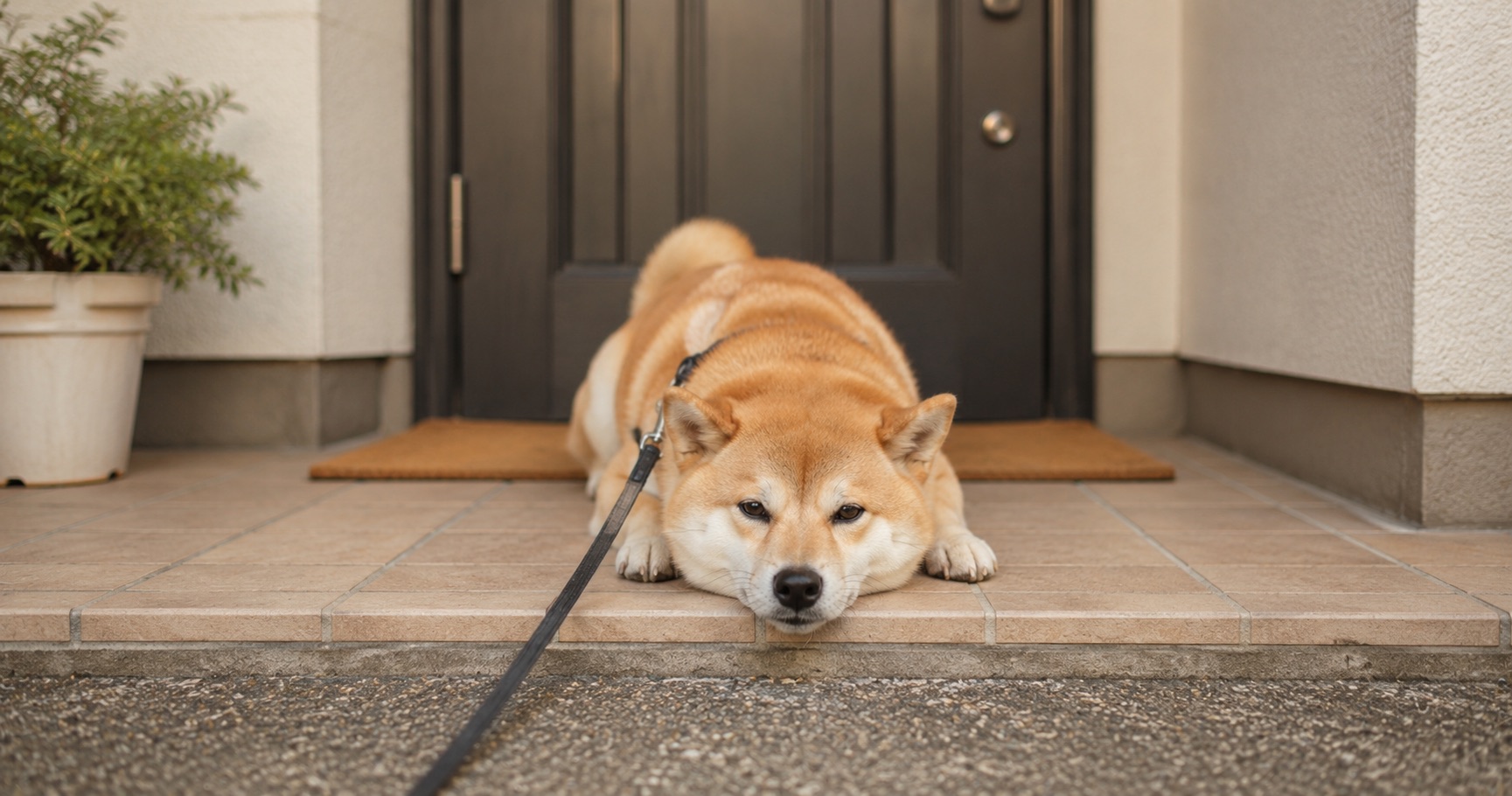
The 5 reasons dogs refuse walks
They're ordered by how common they are. Check from the top down.
| Cause | How to check | Fix |
|---|---|---|
| Weather | Do they only refuse on summer afternoons or in deep winter? | Shift the hour; a coat in winter |
| Paw pain | Do they pull away when you touch a paw, or lick it? | Inspect the pads, then the vet |
| Gear discomfort | Do they run the moment the harness comes out? | Check the fit, replace it |
| Scary memory | Do they only freeze at a specific corner or sound? | Change the route, re-adapt slowly |
| Illness | Has their energy dropped at home too? | Straight to the vet |
Why dragging makes it worse
Pulling a planted dog by the leash damages two things: their neck and shoulders, and their feelings about walks. Once "walks are scary" gets learned, it takes far longer to unlearn.
Instead, sit down right there with them and wait. Try luring a few steps with a treat, and if they still say no, call it a day. Missing one walk isn't a disaster. From your dog's side, it's an experience of my signals being respected, and that builds up too.
How to check if it's the season
That winter when Gureum dug in her heels, the cause turned out to be the ground. After a snowy day she'd walked a street treated with ice-melt salt, and from then on she avoided that one corner. I washed her paws, changed the route, and she walked like nothing had ever happened.
In summer, check the asphalt first. Press the back of your hand to the pavement for 5 seconds. If it burns you, they can't walk on it. Moving the walk to dawn or night is the answer.
Knowing the date the refusal started solves half the mystery
Log your walks in kkeung and every walked day gets a paw stamp, with distance and time stacking up by date. Find the first day the paw stamps stopped, recall that day's weather or any gear you'd just changed, and the process of elimination speeds way up.
Fill in your paw stamps →When to go straight to the vet
If elimination gets you nowhere and any of the following overlaps, the vet comes first. Their walking has slowed. They avoid stairs. There's a spot they don't want touched. They're eating less. Walk refusal is one of the few ways dogs can express pain. Small dogs in particular very often refuse walks because of kneecap problems.
Trace back to the day it started
The shortcut to the cause is the timeline. Pin down when it began, and you just have to find what changed around then. The day the new harness arrived, the grooming appointment, the vaccination, the day the construction noise started. In our house it took flipping the calendar backwards to find that the snowy day was the starting point.
Once the timing is pinned, the response gets simple. New gear? Switch back to the old one. Post-vaccination? Rest a few days. A specific sound? Avoid that hour. But if there's no clear start point and it's been a slow decline, aging or illness becomes more likely, and a vet check moves to the front of the line.
After they start walking again
Once the cause is solved and your dog is walking again, keep the difficulty low for a while. Short routes, quiet hours, their favorite direction. Good experiences during recovery are what write over the memory of refusing. Reintroduce the places and objects from the refusal period slowly, paired with treats.
Above all, remember that refusal is a signal your dog is sending, not defiance. Every time you read the signal, their trust in you deepens, and that trust makes the next problem far easier.
One last thing. On the days the refusal gets you down, remember your dog had their reasons too. A dog whose person goes looking for the why is a lucky dog. Reading this far is proof of exactly that.
Frequently asked questions
It's been days of refusing. Can I just let it be?
Is carrying them out and setting them down outside okay?
I'm worried luring with treats will become a habit.
They play fine indoors and only refuse walks. Do we still need the vet?
They refuse walks but will only go to the bathroom outside. What do I do?
This article is general information and does not replace a veterinary diagnosis. Talk to your vet about your dog's condition.