What's the Best Time of Day
to Walk Your Dog?
Do you walk at a set time, or whenever the moment allows? There isn't one right answer, actually. It changes with the seasons, and summer and winter are complete opposites. Here's the season-by-season breakdown.
In summer, go early morning before sunrise or after 8 p.m. In winter, flip it: the sunny midday hours are best. Spring and fall are wide open, except on days with poor air quality. And more important than the hour itself is keeping a similar rhythm every day.
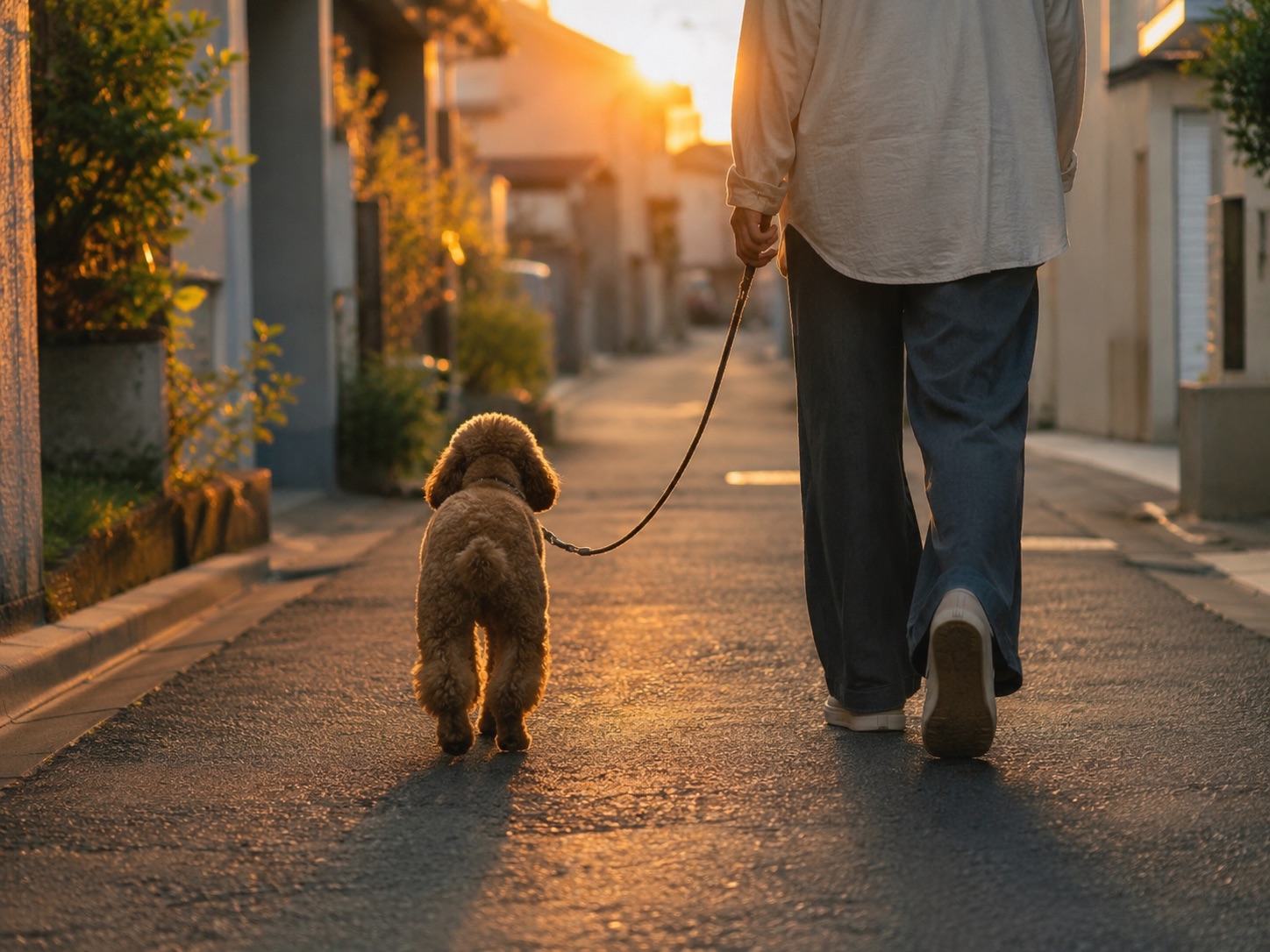
Recommended walking hours by season
| Season | Best hours | Hours to avoid | Why |
|---|---|---|---|
| Summer | Dawn to 7 a.m., after 8 p.m. | 10 a.m. to 6 p.m. | Burned paws on hot asphalt, heatstroke |
| Winter | 11 a.m. to 3 p.m. | Early morning, late night | Keeping body heat up |
| Spring & fall | Anytime | Poor air quality days | Respiratory irritation |
For summer, remember just one rule: press the back of your hand to the pavement for 5 seconds. If it's too hot for you, it's a no-go hour for your dog. Once summer hits, I just lock our walk in at 9 p.m. It feels like a chore at first, but once it's a habit, the cool air makes it the best part of the day.
More important than the hour: rhythm
Dogs can't read clocks, but their bodies keep time. A dog who goes out at 7 every evening starts pacing by the door at 6:50. That anticipation is one of the great joys of their day. My dog Gureum (it means "cloud" in Korean) walks at 8 on weekday evenings, and by 7:50 she's already sitting by the front door. The rhythm is in her body.
So a steady rhythm beats scattered timing. It doesn't have to be the exact same minute. Anchor walks to the flow of the day, like once after breakfast and once after dinner, and it's easier on everyone.
Morning walk vs. evening walk: what's the difference?
A morning walk takes care of the bathroom needs held in overnight and starts the day on a calm note. An evening walk burns off the day's energy so your dog sleeps deeply at night. If you can manage two outings, short in the morning and long in the evening is a solid combination.
If you can only do one, I'd pick the evening. A dog who heads into the night with leftover energy tends to whine at dawn, or turn into an early riser you didn't ask for.
Morning household or evening household? Your walk log knows
Log your walks in kkeung and the time and length of each one stacks up by date. Skim a month of entries and many households discover their weekday and weekend rhythms are completely different. When you're deciding whether to shift your schedule, this list beats gut feeling.
Check this week's walks →When shifting the schedule, go slow
When the season turns and walk time needs to move, an overnight switch confuses your dog. Their potty rhythm is set to the clock too. Shift by 30 minutes at a time over several days. Going from 6 p.m. to 9 p.m.? Give it about a week and nudge it back little by little.
If your dog paces by the door at the old time during the transition, redirect with indoor play or a treat-based nose work session. Make the walk at the new time a little longer and more fun than usual, and the new rhythm settles in faster.
If your schedule is all over the place
Shift workers, freelancers, anyone whose days never look the same: there's a trick for you. Fix the sequence instead of the clock. Whatever the hour, first walk 30 minutes after breakfast, second walk after dinner. You're tying walks to life events rather than times. Dogs remember sequence better than clock time, so this way your dog gets a predictable day even inside an unpredictable schedule.
On days when it truly won't work, leaning on family, a pet sitter, or a dog-walking service is a fine move. One missed walk isn't the problem. The same gap repeating daily is.
To sum up: the best walking time isn't someone else's timetable. It's the time your household can actually keep every day. Shift it gently with the seasons, and build that hour your dog waits for by the door. That waiting is half their day.
Frequently asked questions
Are late-night walks okay?
Can we head out right after a meal?
Should we skip walks entirely when air quality is bad?
Is more than three walks a day too much?
Will a sudden schedule change be hard on my dog?
This article is general information and does not replace a veterinary diagnosis. Talk to your vet about your dog's condition.