How to Start Brushing Your Dog's Teeth:
The 4-Step Adaptation
Full honesty: I failed at toothbrushing several times. Toothbrush in hand, I'd approach: my dog Gureum would vanish under the couch (it means "cloud" in Korean). Only after the vet pointed out her reddening gums did I walk the sequence properly. These days she comes and sits in front of me when the brush appears. Here's that process, exactly as it went.
Toothbrushing adapts in 4 steps: mouth-handling, toothpaste tasting, finger brush, real brush: at 1-2 weeks per step, most dogs get there. Target: daily, minimum 3x a week. And the toothpaste MUST be dog-specific: the fluoride and xylitol in human toothpaste are harmful to dogs.
Is brushing really necessary?
Veterinary guidance holds that the large majority of dogs over age three carry some degree of periodontal disease. Once tartar hardens, no brush removes it: that takes a dental cleaning under anesthesia. So brushing isn't tartar REMOVAL: it's the daily sweep of plaque before it ever becomes tartar. Plaque starts hardening within a day or so, which is why once a week doesn't cut it.
Learned this on the job: bad breath is the first sign of a brushing shortfall. By the time Gureum's breath went sour, her gums were already red. Starting BEFORE the smell is the easy version.
The 4-step adaptation
| Step | What happens | Duration | Graduation |
|---|---|---|---|
| 1. Mouth-handling | Lift the lip, rub the gums lightly with a finger, treat | 1-2 weeks | No head-pulling at a lifted lip |
| 2. Toothpaste tasting | Dog toothpaste on a finger, let them lick | 3-7 days | They approach at the sight of the tube |
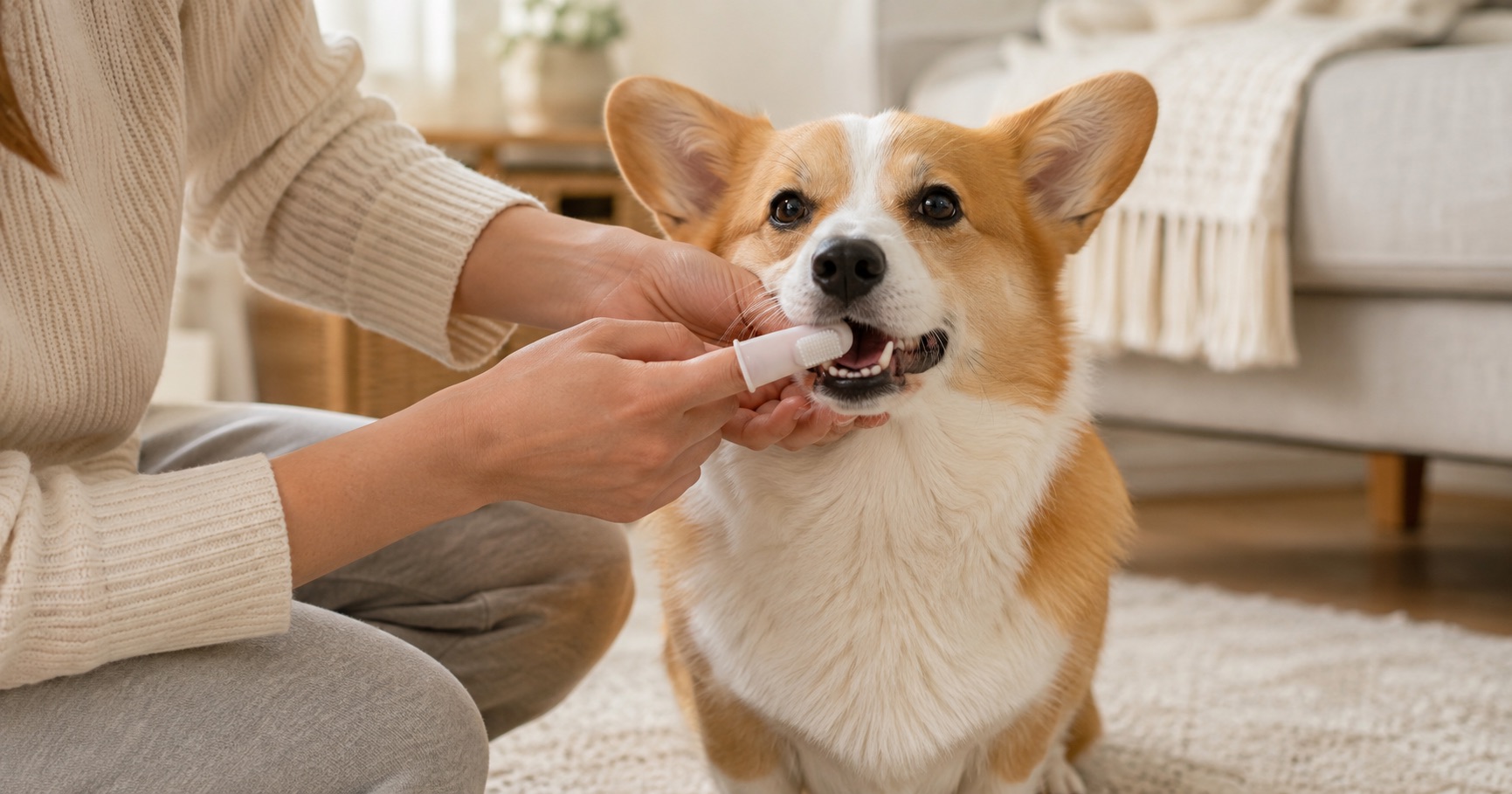
| 3. Finger brush | Silicone finger brush on the front teeth and canines first | 1-2 weeks | They allow reach to the outer molars |
| 4. Toothbrush | Small-dog brush, outer surfaces, starting at 30 seconds | Ongoing | Target one minute, daily |
* Stuck on a step: drop back one. Retreat isn't failure.
The governing rule: end every step BEFORE they start disliking it. If 30 seconds draws resistance, end at 20. And the ending is always a treat or play. Teaching the body that brushing is followed by good things: that's the entire program.
Where, and how, to brush
- Outer surfaces first. The tongue handles the inner faces reasonably well: the cheek side is where tartar stacks.
- The outer upper molars are the priority: nearest the salivary glands, first place tartar hardens.
- Brush at 45 degrees along the gumline, gentle small circles. Pressure injures gums.
- No need to open the mouth. Closed mouth, lifted lip: every outer surface is reachable.
Thirty seconds at first: one minute once fluent: that's plenty. Chasing a perfect clean until the dog sours on the whole enterprise is the worse trade. Right side today, left tomorrow: our house still splits it that way plenty of days.
First successful brushing: worth commemorating
The day they first accept the toothbrush is a weeks-long achievement in one moment. Videos posted to kkeung keep their dates and collect likes from the neighborhood dogs: and other households' brushing videos in the neighborhood feed usually hold one trick that fits your dog too.
Show the neighborhood dogs →What if they refuse to the end?
Change the toothpaste
Flavor rejection is more common than you'd think. Chicken, peanut butter, vanilla: the flavors run wide, so trial two or three. Gureum despised the mint family and tried to EAT the chicken one.
Change the tool
Brush refused: a finger brush, or gauze wrapped on a finger with toothpaste, still works. Less effective than a brush: enormously better than nothing.
The supporting cast
Dental chews, oral sprays, and water additives don't replace brushing. What they do: slow the plaque-hardening clock for a dog still mid-adaptation. Pick dental chews sized against swallowing whole.
Toothbrushing was never about making a dog LOVE it: it's about making it tolerable. Your dog isn't unusually difficult. Most dogs are like this. Go slow: slow works.
Frequently asked questions
Can't I just use a little human toothpaste?
How many times a day?
There's already heavy tartar. Will brushing remove it?
When do puppies start?
I miss a lot of days. Is every-other-day even worth it?
This article is general information and does not replace a veterinary diagnosis. Talk to your vet about your dog's condition.