Heavy Shedding:
Telling Coat-Blow from Illness
Bichons are billed as a low-shedding breed: and they still shed. But one spring I found a round bare patch on my dog Gureum's side (it means "cloud" in Korean). I filed it under shedding season and moved on: the clinic filed it under ringworm. Here's the sorting method I learned that week.
Even loss across the whole body: shedding season. A bare patch, or red skin underneath: likely disease. Seasonal coat-blow runs 2-6 weeks in spring and fall and yields to brushing: but round bald spots, itching, or dandruff alongside means a vet visit.
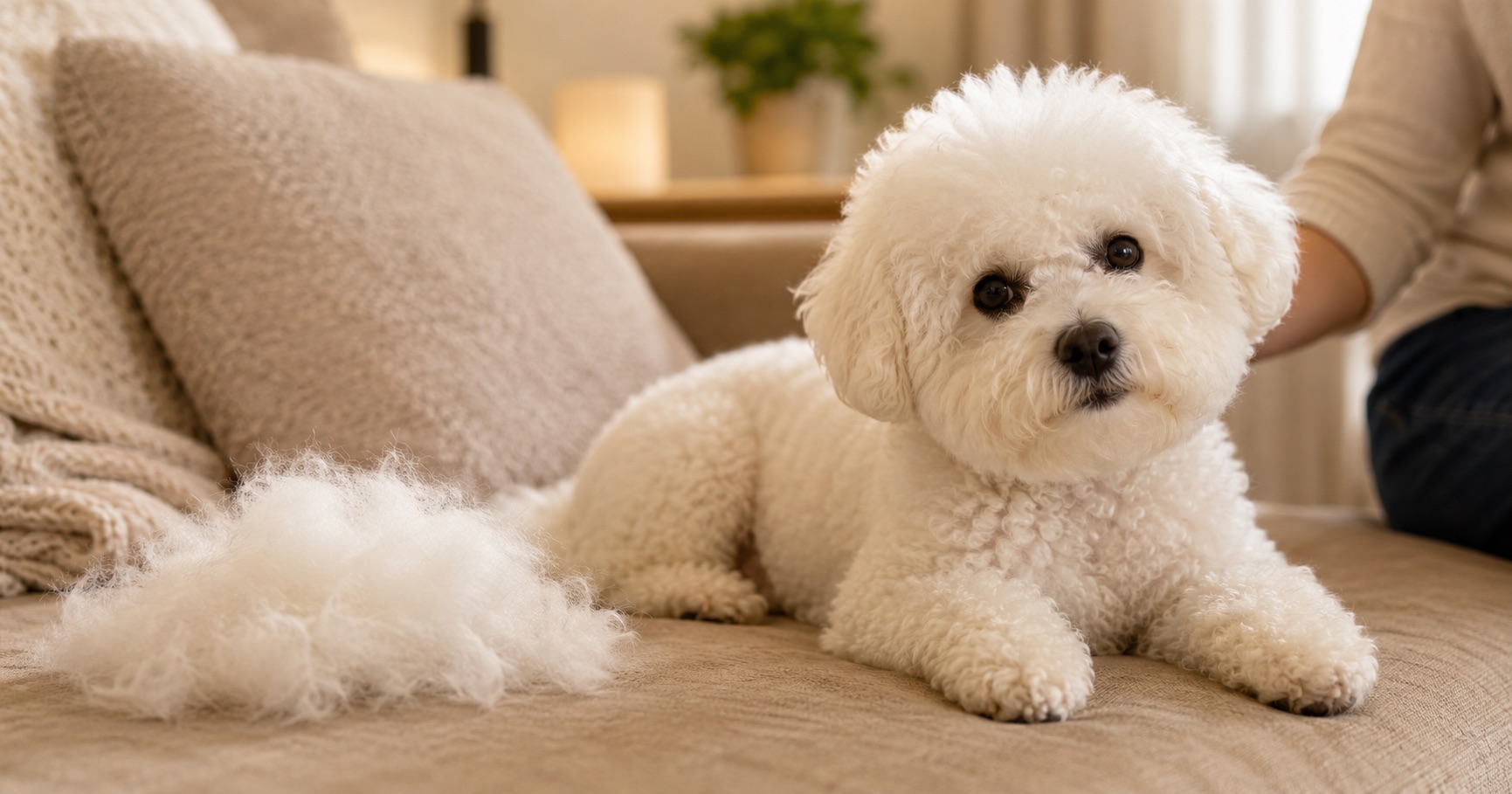
Why the sudden heavy shedding?
Shedding causes run in three branches: seasonal coat-blow, stress or nutrition, and skin or hormonal disease. The first two are home-manageable: the third belongs to the clinic. So the sorting comes first.
| Shedding season (normal) | Disease-driven loss (clinic) | |
|---|---|---|
| Where it falls out | Evenly, everywhere | Specific patches: round, or symmetrical on both sides |
| Skin underneath | Clean and pink | Red, flaky, scabbed, darkening |
| Itching | Little to none | Scratching, licking, body-rubbing |
| Timing | Spring and fall, 2-6 weeks | Season-independent, spreading |
| Alongside | Nothing | Heavy drinking, weight gain, low energy (hormonal suspects) |
* Skin showing through, or hair pulling out in clumps at a tug: skip the season math and go to the clinic.
When, and for whom, is coat-blow worst?
Thick-undercoated double-coat breeds: Pomeranians, Shibas, Golden Retrievers, Corgis: dump the whole winter undercoat in spring. Daily brushing still fills a fist during those weeks. Single-coated breeds: Poodles, Bichons, Maltese: skip the visible coat-blow, but their shed hair tangles into the curls instead of dropping. These dogs don't shed less: they DROP less. Skip the brushing and it clumps inside, and the skin under a clump goes damp and breaks out.
Indoor dogs blur the calendar entirely: central heat convinces the body it's a different season, so they shed lightly year-round. Odd-looking, not abnormal.
What actually reduces the shedding?
- Daily brushing. Catching dead coat before the floor does: nothing beats it. Undercoat rake for double coats, slicker for curls.
- One extra bath during coat-blow. Water flushes dead coat in bulk: but only if the blow-dry includes brushing.
- Check the food's protein. Hair is built from protein: low-protein diets grow brittle, shed-prone coat.
- Omega-3s. They support the skin barrier: but budget 6-8 weeks minimum before judging the effect.
- Audit the stress. Moves, family changes, and walk shortages all show up in the coat for some dogs.
Ours is a no-coat-blow breed, and one skipped brushing day still buys a small armpit clump by morning. Five minutes of brushing keeps preventing thirty minutes of detangling.
Coat photos make the comparison possible
Coat-blow or condition: the answer needs time-lapse. Shoot the shedding area from the same angle and post to kkeung: each keeps its date, showing whether a bare patch is widening or the loss stays even across weeks. At the appointment, the feed IS the history.
Save a photo of today →The go-to-the-clinic signals
Round bald spots
A coin-sized circle of loss with flaky or crusted edges puts ringworm first on the suspect list. This was Gureum's case: and it can spread to humans, so speed matters.
Symmetrical loss
Both flanks or both thighs thinning in mirror image, WITHOUT itching, points toward hormones: thyroid, or adrenal (Cushing's). Heavy drinking and a sagging belly often ride along. Bloodwork sorts it.
Scratched and licked bare
Allergies, fleas, or ticks are the usual engines here. The bare patch matters less than WHY they're scratching: find that first.
Most shedding is normal-range: hard on the vacuum, easy on the dog. But if any of the three above shows up, don't sit on it. Early skin disease resolves in a week or two of medication: neglected, it runs for months.
Frequently asked questions
Can shedding be eliminated completely?
They're supposedly a non-shedding breed. Why is hair coming out?
Would shaving them down reduce shedding?
Do supplements reduce shedding?
How often do I brush during shedding season?
This article is general information and does not replace a veterinary diagnosis. Talk to your vet about your dog's condition.