Helping a Dog Who Hates Baths:
Water Temperature to Reward Order
My dog Gureum used to slide under the bed at the SOUND of the bathroom door (it means "cloud" in Korean). Carrying her in and washing her worked, technically: watching her tremble through it every time did not. So for one month we did zero baths and nothing but adaptation. She climbs into the tub by herself now. Here's that month, written down.
What dogs hate usually isn't the water: it's the slippery floor, the shower's noise, and water hitting the face. Lay a non-slip mat, keep the water just above lukewarm at 98-100°F, pour with a cup or your hand instead of the sprayer, and start from treats-in-an-empty-tub: climbing one stage every 2-3 days changes things within a month.
Why do dogs hate baths?
Learned this on the job: often it isn't the water at all. Gureum marched into rain puddles happily enough. Crossing off suspects one by one, hers came down to the slippery floor first and the shower noise second. Feet sliding, body restrained, loud water crashing onto the face: a person would hate that too.
| Reason | Signal | Fix |
|---|---|---|
| Slippery floor | Legs splayed, bracing, claws scrabbling | Non-slip mat or a towel down first |
| Shower noise and pressure | Startles the moment water turns on | Cup, hand, or the sprayer held flush against the body |
| Water on the face | Head whipping, sneezing | Face gets a damp towel, separately |
| Water temperature | Cringing or panting | 98-100°F: mildly warm on your inner wrist |
| A bad memory | Flees at the bathroom's general direction | Re-teach the bathroom as where good things happen |
* The dog who always got scolded, or hauled to the vet, right after baths learns bath = bad news incoming. Rewrite what comes AFTER the bath.
The staged adaptation plan
- Stage 1: enter the bathroom, get a treat. No water. Door stays open: they walk in on their own. 2-3 days.
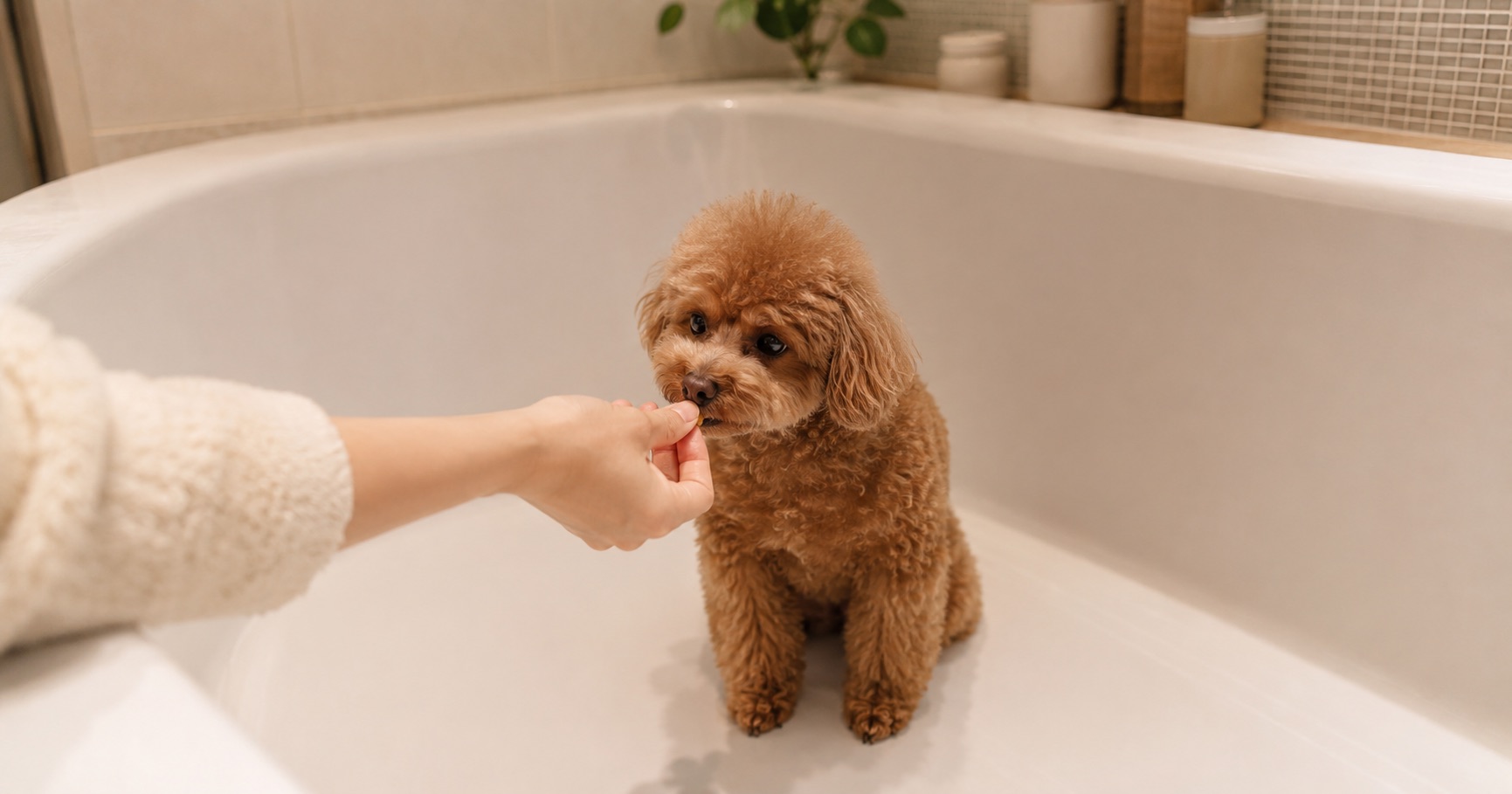
- Stage 2: mat in the empty tub, treats or a lick mat inside it. The tub becomes a dining venue. 3-4 days.
- Stage 3: while they're in the tub, water flicks on briefly at a distance, then off. The sound stage. 2-3 days.
- Stage 4: lukewarm water just deep enough to touch paws, treats in the water. 3 days.
- Stage 5: one cup of water over the back, treat. Two cups, treat. Build from there. 3-4 days.
- Stage 6: a real bath, short: done inside 5 minutes, followed immediately by a favorite game.
The load-bearing rule: end every stage BEFORE they start disliking it. Once the whining starts, you're already late. Stuck on a stage: drop back one. Retreat isn't failure: it's pacing.
Designing the mid-bath rewards
Both hands are busy mid-bath: treats can't happen. Enter the lick mat. Stick it to the tub wall, smear it with peanut butter or wet food, and wash the back while they work it. The day the lick mat debuted, Gureum climbed into the tub on her own. After the bath, towel-dry into a short round of their favorite tug game. A bath that ENDS well makes the next one easier: that's the whole engine.
The day they climb in alone: worth bragging about
A water-fearful dog stepping into the tub by themselves is a real milestone. Videos posted to kkeung keep their dates and collect likes from the neighborhood dogs: set it beside week one's footage and the distance traveled shows plainly.
Save a video of your dog →What if a bath is unavoidable mid-adaptation?
Bridge with spot washes
For the adaptation month, postpone full baths: paws and belly after walks, brushing and fragrance-free wipes for the rest. Force a bath mid-program and the accumulated progress collapses.
If they truly must be washed
Rolled in mud: no choice. Then use a DIFFERENT venue: the sink, a big basin: and finish fast. The point is protecting the tub's new reputation as a good place.
The groomer option
Outsourcing baths to a groomer until adaptation completes is a legitimate strategy. If the groomer IS the trauma source, try mobile grooming or a quieter shop instead.
Back when I carried a trembling dog into the bathroom, I thought that was the best available option. In hindsight: one invested month bought more than a decade of easy baths. Your dog isn't unusually cowardly. Most dogs are like this: and most dogs come around.
Frequently asked questions
Is it okay if adaptation takes over a month?
How do I get the water temperature right?
If they start whining mid-bath, do I stop?
I'm handing out a LOT of treats. Is that okay?
Why do they sprint around like mad after a bath?
This article is general information and does not replace a veterinary diagnosis. Talk to your vet about your dog's condition.