Bowl Height: Does It Really Matter
for a Dog's Health?
Bowl height sounds like a trivial detail, until you consider it's a motion performed twice a day, every day, for a lifetime. How far the neck bends per meal: that compounds. The standard is simpler than you'd think, with one genuine controversy in large breeds.
The base principle: a height where the neck doesn't bend sharply while eating standing, roughly a bit below shoulder level. For small dogs, a 2-4 inch riser often covers it. Seniors, dogs with neck-disc history, and frequent post-meal regurgitators benefit from elevated bowls. The exception: for large breeds at bloat risk, elevated bowls are actively debated, so that call goes through the vet.
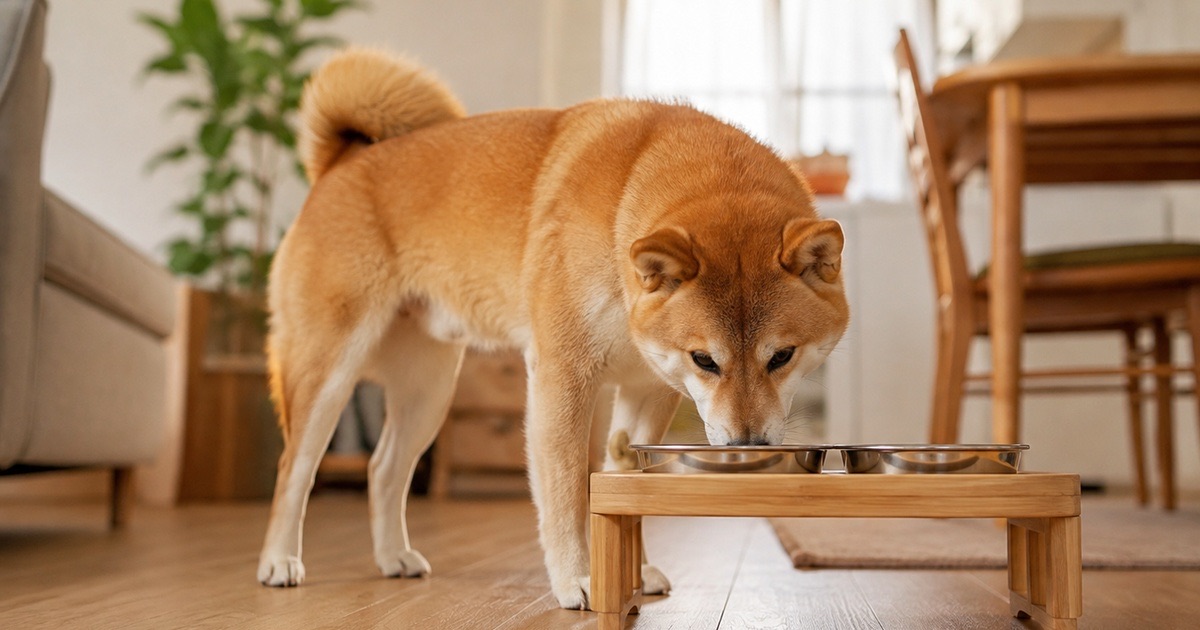
Height guide by body type
| Body type | Suggested height | Note |
|---|---|---|
| Toy (under 6.6 lbs) | Floor to 2 in | Too high is its own discomfort |
| Small (6.6-22 lbs) | 2-4 in | Use shoulder height as reference |
| Medium | 4-8 in | Fine-tune by watching their posture |
| Large | Individual | Bloat history or risk: vet consult |
| Seniors, all sizes | One notch higher | Eases joint and neck load |
The real ruler is observation, not numbers. Watch a meal from the side. A neck folded so far the face nearly buries in the floor means too low; front legs splayed in a hunched crouch is another signal. At a comfortable height, the backline flows naturally and the legs stand settled.
Where elevated bowls especially help
First: seniors. For weakening necks and forelegs, a few inches of lift alone makes meals easier. Second: neck-disc-risk breeds (Dachshunds among them) or dogs with a history. Third: dogs who frequently burp up kibble after meals sometimes improve as the esophageal angle eases. Fourth: flat-faced breeds who run short of breath at a floor bowl. In these cases, an adjustable stand lets you hunt the sweet spot height by height.
The large-breed bloat controversy: decide informed
Elevated bowls were once the standard advice for large breeds, until later research linked them with a possible RISE in bloat (gastric torsion) risk, and the debate began. Bloat is a life-threatening emergency in deep-chested large dogs, so this isn't a controversy to shrug past. If yours is a relevant breed (Great Danes, German Shepherds, and other large breeds), set the bowl height with your vet rather than the trend, and pair it with the managements that matter alongside: no hard running right after meals, and no speed-eating.
Mealtime posture, on video, becomes comparable
Whether the height fits shows in how they eat. Film a short side-angle clip of a meal and post it to kkeung: the post keeps its date, so before-the-new-bowl and after sit side by side.
Save a video of your dog →While you're at it: material and shape
Adjusting the height is the moment to audit the bowl itself. Stainless and ceramic win on hygiene; a scratched plastic bowl collects bacteria and sometimes causes chin acne. For the dog who chases a sliding bowl through every meal, a non-slip base or a mat is the fix. And for sensitive dogs who hate their whiskers brushing the walls, a wide shallow bowl fits better. With daily-use objects, small discomforts become large stresses.
Change one thing at a time, days apart
Swap the height, material, and location all at once and a sensitive dog may answer with a hunger strike. One change at a time, a few days apart. Serve treats in the new bowl first to build a good first impression, and adaptation speeds up. Then watch a week of eating speed, posture, and regurgitation: improved means keep it, unchanged means revert. Bowls are a low-cost experiment zone, so try things freely. When my dog Gureum's bowl went up on a 2-inch riser (it means "cloud" in Korean), she ate sideways around it for two days, and by day three the posture clicked in.
Frequently asked questions
Can the food and water bowls sit at different heights?
Can I prop the bowl on books or a box instead of a stand?
They eat lying down. Is that okay?
Could regurgitating right after meals be a bowl-height thing?
What's the best bowl material?
This article is general information and does not replace a veterinary diagnosis. Talk to your vet about your dog's condition.