5 Ways to Slow Down a Dog
Who Eats Like a Vacuum
The bowl touches the floor and three seconds later it's empty: a speed that makes you doubt any chewing occurred. "Great appetite" is the wrong takeaway: speed-eating is a genuinely risky habit, and doubly so for large breeds. Here are five proven ways to bring the pace down.
Speed-eating links to vomiting, choking, indigestion, and bloat risk in large breeds. Five fixes: a slow-feeder bowl, scatter (nose work) feeding, splitting meals, separated feeding in multi-dog homes, and removing whatever makes them rush. For many dogs, the slow feeder alone multiplies mealtime severalfold.
The 5 methods
| Method | Principle | Point |
|---|---|---|
| 1. Slow-feeder bowl | Tongue-work between the ridges | Products come in difficulty tiers |
| 2. Scatter feeding | Convert eating into searching | Snuffle mat, or scatter on a blanket |
| 3. Split meals | Shrink each sitting's volume | 2 meals a day into 3-4 |
| 4. Separated feeding | Remove the competition | Multi-dog homes: mandatory |
| 5. Calm environment | Remove the anxiety triggers | Quiet spot, no mid-meal interference |
Why the rush, anyway?
The reason picks the method. Multi-dog home: competition is the likely driver. Eating under the tension of a rival eyeing your bowl becomes a race. Here, space separation beats any slow feeder: fed in separate rooms or crates, the pace often drops on its own. An only dog who still inhales may carry innate food drive or littermate-competition memories: for those, slow feeders and scatter feeding land well.
Using a slow feeder properly
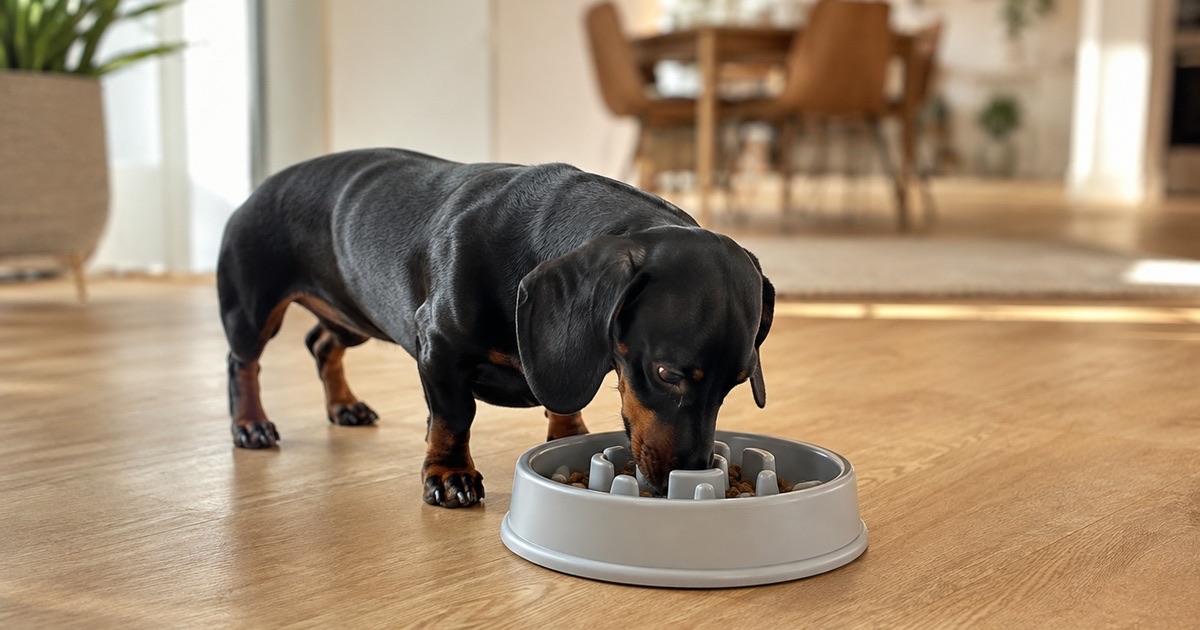
Maze difficulty varies by product, and opening with expert-level ridges produces either a frustrated dog who quits or one who invents the bowl-flip technique. Start medium, adjust by how they adapt. Suction-bottom models prevent the flip; check that the ridges clean easily, since gunk between them is a hygiene headache. Flat-faced breeds struggle with deep mazes: wide and shallow fits them. And if slow feeders just don't take, kibble spread across a wide tray slows things considerably on its own. My dog Gureum flipped hers on day one (it means "cloud" in Korean); only after switching to a non-slip base did we achieve the three-minute meal.
Scatter feeding turns dinner into a game
A dog nosing out their kibble piece by piece is prime bragging material. Short clips on kkeung keep their dates and collect likes from the neighborhood dogs, and browsing the local feed's scatter-feeding setups tends to spark new ideas of your own.
Show the neighborhood dogs →A sudden SLOWDOWN is a signal too
Know the reverse case as well. The lifelong vacuum who abruptly starts picking and dawdling hasn't improved: they may be signaling trouble. Tooth pain making chewing uncomfortable, an unsettled stomach, or a throat that feels off: eating speed drops first. Chewing on one side only, mouthing then dropping kibble, or eating with a tilted head stacking on top points strongly to an oral issue: book an exam. Eating speed is a health gauge in both directions.
Emergency management for the rushed-meal day
Forgot the slow feeder, or they bolted a meal away from home: block hard play and sprinting for 30-60 minutes after. For deep-chested large breeds especially, post-meal exercise ranks among bloat's risk factors. If dinner-then-walk is your routine, open with a slow, potty-first stroll and push the ball game past digestion time. And after a bolted meal, repeated dry heaving, a swelling belly, or restless pacing can be bloat's emergency signals: go to the vet immediately.
Frequently asked questions
Won't a slow-feeder bowl stress them out?
Can wet food go in a slow feeder?
Multi-dog home: one dog raids the other's bowl.
Frequent choking and hacking: is it the speed?
Slow feeder in use, still inhaling. Next step?
This article is general information and does not replace a veterinary diagnosis. Talk to your vet about your dog's condition.