Why Do Dogs Dig?
Instinct, Boredom, or Cooling Off: How to Tell
Our walk buddy Sausage the dachshund has five holes in his yard. His owner swears he was born to dig, and she's not wrong. Dachshunds were literally bred to go after badgers in their burrows. My dog Gureum (it means "cloud" in Korean) has no yard, so she digs my blanket instead. Turns out that's a whole different reason.
Digging comes down to one of six things: instinct, nesting, temperature control, boredom, anxiety, or escape. Scratching the blanket and circling before sleep is nesting instinct, and perfectly normal. Digging into shaded dirt on a hot day is temperature control. The real problems are daily yard excavation and digging under the fence, and those are usually about leftover energy. More walks and play, plus a designated digging zone, will bring it down.
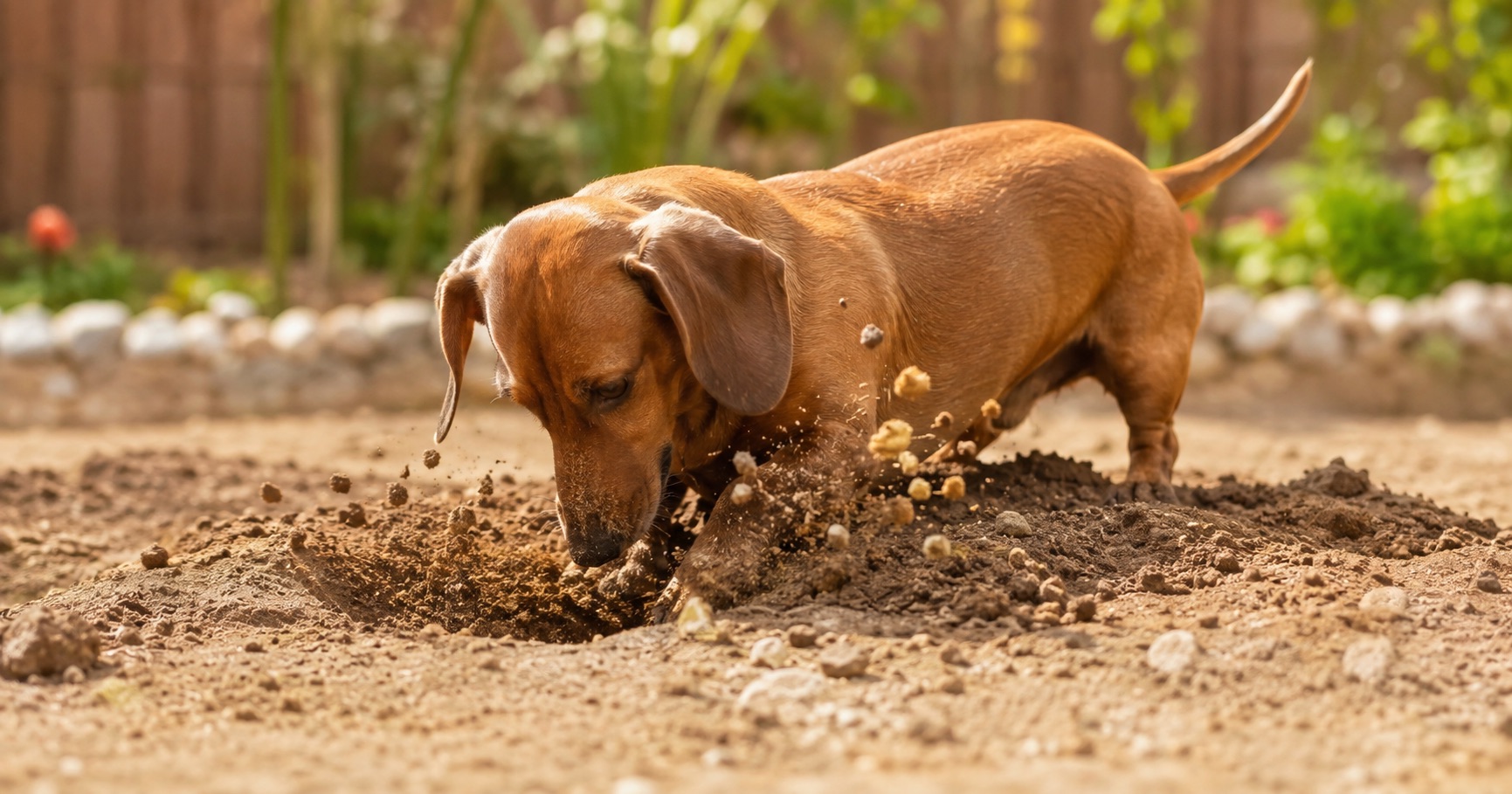
Why do dogs dig in the first place?
Dogs' ancestors dug to cache food, to den up and raise their puppies, and to find cool earth on hot days. Those habits stuck around, which is why dogs without yards dig blankets, couches, and cushions instead. Then add selective breeding on top: terriers and dachshunds were bred to dig out burrowing animals, and huskies dug sleeping pits in the snow. So digging itself isn't the problem. What matters is why they dig, because the fix depends on the cause.
| Reason | What it looks like | Typical dogs | What to do |
|---|---|---|---|
| Instinct (hunting) | Focused digging while sniffing at the ground | Terriers, dachshunds, beagles | A legal dig zone, nose work |
| Nesting | Scratching bedding and circling before sleep | All breeds; pregnant females | Normal, leave it be |
| Temperature control | Shaded dirt on hot days, under leaves when cold | Double-coated breeds, dogs with yards | Provide a cool spot and water |
| Boredom | Same spot every day, while you're away | Active dogs short on walks | More walks and play |
| Anxiety | By the door, on the doormat, when left alone | Dogs with separation anxiety | Practice alone-time |
| Escape | Under the fence, next to the gate | Intact males; when something's outside | Reinforce the fence, ask your vet about neutering |
Is digging at blankets or the couch okay?
Scratching the blanket a few times, circling, and nudging it into shape with their nose before sleep is bed-making instinct: the same motion wild dogs used to flatten grass into a bed. There's no need to stop it, and you couldn't anyway. But if your dog is shredding couch cushions or the mattress rather than shaping a bed, that's an energy problem, not a bedtime routine. And if they only dig at the carpet or doormat after you leave, that points to anxiety. Leave the blanket digging alone; only the destructive and anxious kinds need addressing.
Here's something I learned along the way: Gureum digs at my blanket and then buries her nose in it to sleep. It's where my scent is strongest. I used to stop her, worried about the blanket. Now she has her own worn-out one, and she digs it to her heart's content.
How do I reduce digging?
- Add walks and playtime. Most diggers simply have energy to spare. Terriers and dachshunds in particular may need more than two walks a day.
- Create a legal dig zone. A sandbox in a corner of the yard with buried toys teaches them to dig only there. Indoors, a pile of blankets or a snuffle mat does the same job.
- Interrupt only in the act. Scolding over a hole after the fact connects nothing. Call their name as they start digging and redirect to another game.
- Lay stones or wire mesh over favorite spots and they'll give up on those.
- If it's the heat, provide shade, a cool floor, and water. Remove the reason and the digging goes with it.
- Digging under the fence? Check what's on the other side. It could be a female in heat or another dog.
The difference between a digging day and a calm day is the walk
Trace back the days a new hole appeared and you'll usually find a skipped walk. Log your walks in kkeung and distance and time stack up by date, with a paw stamp on every day you walked, so the connection is right there in front of you. Move up to two walks a day and the holes stop multiplying.
Start tracking walks →Digging tips by breed and situation
If you have a terrier or dachshund
Don't try to eliminate digging. For these dogs it's as natural an outlet as barking. Change what they dig instead: a sandbox, treats hidden in blankets, toys buried in dirt. Meet the urge, and your garden and couch stay safe.
If the digging started suddenly in summer
That's temperature control. Freshly dug earth is several degrees cooler than the surface. Put a cooling mat or a damp towel in the shade and they won't bother digging. Shift summer walks to early morning or night, and offer water often.
If they only dig after you leave
That's anxiety digging, and walks alone won't fix it. Give them a job before you go (nose work or a long-lasting chew) and build up alone-time starting with short outings. If the digging happens near the door, it's almost certainly this.
A cratered yard and a shredded blanket are maddening, I know. But your dog is busy doing exactly what they were born to do. Our job is to redirect that purpose somewhere else, not to erase it.
Frequently asked questions
Why does my dog hide treats in the blanket?
Is circling before lying down related to digging too?
How do I satisfy the digging urge in an apartment with no yard?
My dog eats dirt while digging, is that okay?
My senior dog suddenly started digging at their cushion
This article is general information and does not replace a veterinary diagnosis. Talk to your vet about your dog's condition.