The Doorbell Detonator:
Defusing It with Sound Desensitization
Ding-dong. For a long time, those two syllables were our house's declaration of war. The delivery driver was innocent: my dog Gureum charged the door anyway, delivering her full speech (it means "cloud" in Korean). Doorbell barking isn't restrained by willpower: it's a conditioned reflex: so the fix has to REWRITE the reflex. That method is sound desensitization.
Doorbell barking is the conditioned reflex doorbell = intruder alarm. The fix runs on two rails. 1) Desensitization: play a recording of the doorbell VERY quietly, pair with treats, bank no-reaction successes, and raise the volume gradually. 2) Replacement behavior: when the bell rings, going to a designated spot (mat, crate) instead of barking earns the reward. Scolding or yelling reads, to the dog, as YOU joining the alarm: it reinforces the barking. Budget several weeks of repetition.
The desensitization steps
| Step | Method | Point |
|---|---|---|
| 1. Capture the sound | Record YOUR doorbell | Identical sound is essential |
| 2. Low-volume exposure | Barely audible playback + treats | Start below the barking threshold |
| 3. The volume staircase | No reaction: nudge it up | Barking: drop one step back |
| 4. Live integration | A family member rings the real bell | Announced live runs first |
The principle is rewiring sound to emotion. A sound that meant ALARM, experienced hundreds of times at low volume as a treat-announcement, keeps its new circuitry as the volume climbs. Five minutes a day, in the focused pre-meal window, does it.
Replacement behavior: give them a job instead
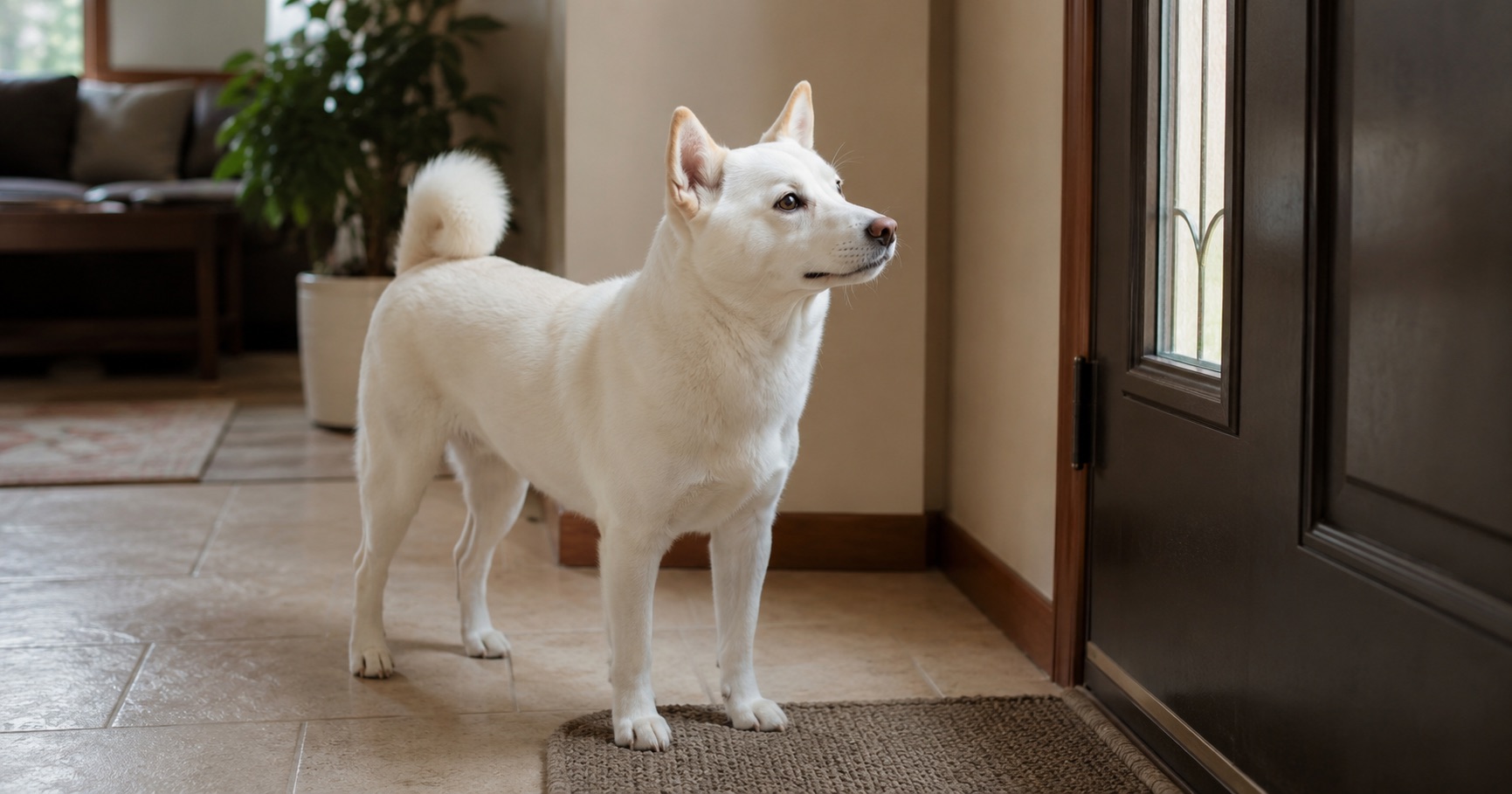
Don't bark is hard to train because DON'T never explains what TO do. So plant a different behavior in the bark's parking spot. The recommendation: go to your spot. First teach the mat cue with no doorbell anywhere: then chain it: recorded bell → mat cue → treat ON the mat, repeated. At mastery, the bell itself becomes the cue: mat = incoming treat. That's our house's finished build: these days the ding-dong sends Gureum to her mat, where she sits and stares at me. The where's-my-treat eye contact is a little entitled: but it beats war.
The don't-do list
Yelling to stop it: to dog ears, that's your voice joining the chorus: a full-family alarm that VALIDATES the barking. Scooping up the barking dog can pay the barking too. And the treat-as-muzzle move: a treat given AFTER barking starts: teaches bark-then-treat, the exact reverse lesson. Treat TIMING is everything: it lands on the quiet beat, on the trip to the mat. During training, manage live exposure: a delivery-heavy household can post a leave-at-door note and cut the doorbell traffic itself: a perfectly practical training-season measure.
Before-and-after is the fuel of bark work
Desensitization improves slowly enough to invite quitting. Before starting, post a short clip of the doorbell reaction to kkeung: weeks later, post the same situation again. Both keep their dates: side by side, the change becomes visible: and visible progress keeps you going.
Save a video of your dog →Manage the roots, not just the trigger
Dogs with especially explosive doorbell reactions often run high baseline arousal: surplus energy, a full-time window-surveillance career, broad wariness of strangers. Work the roots alongside the desensitization: drain energy and stress with walks and scent games: partially block the view if window patrol is heavy: dissolve stranger-wariness through guest = treat-dispenser experiences. The doorbell is just a trigger: keep the powder keg full and the alarm relocates to new triggers: hallway footsteps, the neighbor's door. Reducing the powder inventory is the long-term fix.
The apartment-living reality
In an apartment, bark correction is also a neighbor-relations project. Training takes weeks: a short heads-up to the neighbors (a note, an elevator hello: we're working on the barking) drops the conflict temperature dramatically. Most neighbors credit the effort itself. And two distinctions matter: barking that runs all day, or continuous barking when ALONE, may not be a doorbell problem at all: separation anxiety and other causes need a camera check of the pattern, because a different cause means a completely different prescription. Weeks of honest training with no progress: a trainer's house call shortens the maze.
Frequently asked questions
They bark at TV doorbells too. Does that hurt the training?
Wouldn't switching to a silent doorbell solve it?
What about anti-bark collars?
Why do they KEEP barking after the guest is inside?
What about the delivery person, every single time?
This article is general information and does not replace a veterinary diagnosis. Talk to your vet about your dog's condition.