Post-Surgery Care:
From the Cone to the Incision Check
The surgery happens at the clinic: the recovery gets finished at home. The discharge sheet that seemed thorough feels suddenly thin once you're back: is this much swelling okay? They hate the cone THIS much: really keep it on? From spays to dental work, here are the home-care standards that hold across procedures.
Recovery runs on four axes: 1) cone stays on (lick prevention), 2) incision watching (mild swelling normal: discharge and gapping are not), 3) activity limits (no jumps, stairs, sprints), 4) medications exactly as prescribed. The call-the-clinic signals: bleeding, pus-like discharge, a gapping incision, heavy swelling, two-plus days of refusing food, worsening lethargy. And the recheck and suture-removal dates hold even when everything looks great.
The incision: normal vs. call-the-clinic
| Item | Normal healing | Call the clinic |
|---|---|---|
| Swelling | Mild, gradually shrinking | Growing, or a firm lump |
| Color | Light pink; bruising fading | Spreading deep red; turning dark |
| Discharge | Nearly none; scant clear fluid | Pus, blood, foul-smelling ooze |
| Sutures | Holding closed | Gapping, loosened stitches |
| Condition | Appetite, energy back within a day or two | Repeated vomiting; 2+ days refusing food |
Once or twice a day, check the incision in good light and photograph it. Yesterday-versus-today comparison makes better-or-worse instantly readable, and phone consults go smoother when you can send the picture.
Winning the cone war
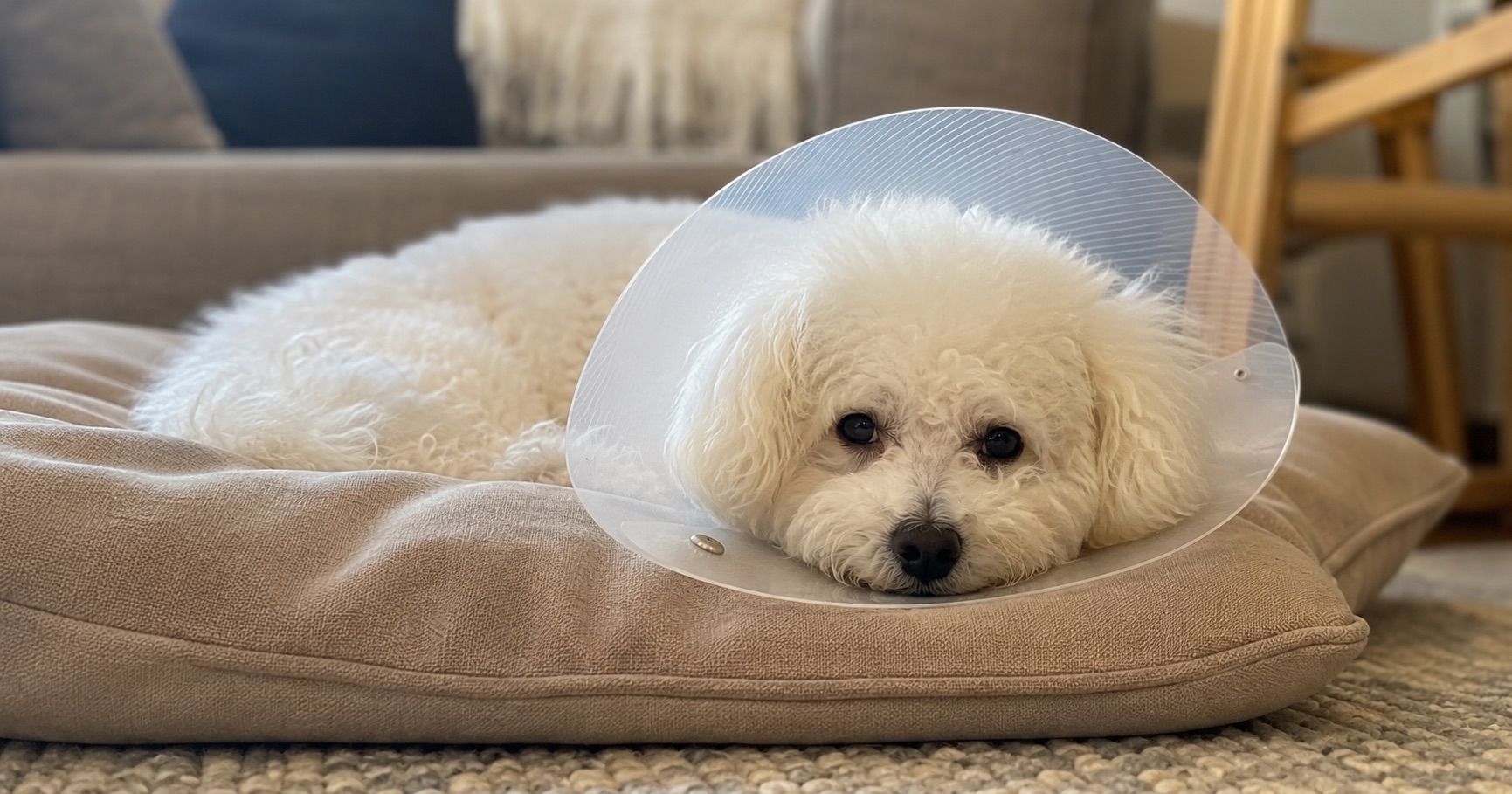
In many households the hardest part of surgery isn't the incision: it's the cone. My dog Gureum protested hers post-spay with full theatrical commitment (it means "cloud" in Korean): backing into walls, spearing the food bowl. Still, one principle: a few seconds of licking turns days of recovery into weeks of treatment: the cone holds until sutures come out. But you CAN ease the adaptation: swap to a narrow, tall food bowl that fits inside the cone; clear the furniture it snags on at bedtime; attach treats and praise to cone-on time. For the truly miserable, cushion and donut styles exist as alternatives: arranged with the clinic, because some styles can't protect certain incision sites. No freelance swaps. We switched to a cushion collar and found peace.
Activity limits: engineered, not requested
A day or two in, condition rebounds and the dog forgets they're a patient: couch leaps, window-cat sprints. Recovery-period limits are enforced by YOUR environment design, never their self-control. Block couch and bed access temporarily; gate the stairs; walks resume only when cleared, short and potty-focused. And when pent-up energy boils over, swap body games for brain games: scatter feeding, find-the-treat: boredom drains, incision spared.
Recovery photos make the recheck count
The incision shifts a little daily: without comparison, the drift goes unseen. Photograph it from the same angle and post to kkeung: each keeps its date, showing the recheck exactly how the swelling and color moved.
Save a recovery photo →Food and meds: the fundamentals
Anesthesia evening: water first in small amounts, then, if it holds, a meal at half the usual or less. Appetite usually returns by the next day: keep the familiar menu through recovery, no new-food experiments. Medications: exact times, exact counts, no stopping early because they seem fine (antibiotics especially run to the end). If dosing is a battle, ask about hiding techniques or a different format. And one trap: a dog on pain medication looking lively may be the DRUG working, not the healing finished: never read the liveliness as permission to lift the activity limits.
Recovery speed is individual
Same surgery: one dog is bouncing in a day, another spends days lying quiet. Rather than measuring against internet recovery stories, compare YOUR dog's yesterday to their today: if the direction is recovery, the speed is personality. What isn't personality: reversal. Eating well then refusing: swelling that faded then returned: those are signals, and the clinic hears about them. And the scheduled recheck happens even when everything looks perfect. That visit IS the final stage of the recovery.
Frequently asked questions
Can we take the cone off for short breaks?
Can a recovery suit replace the cone?
Should I wipe the incision with antiseptic?
Days out and they're still low-energy. What's normal?
Multi-dog home: the other dog keeps trying to lick the incision.
This article is general information and does not replace a veterinary diagnosis. Talk to your vet about your dog's condition.