Training Treats:
Size and Timing Are the Skill
With training treats, HOW you give beats WHAT you buy, ten to one. Same treat, and one household nails "sit" in a week while another circles for a month: the difference lives in size and timing. Here's the professional trainers' technique, translated for home use.
The three principles: small, fast, tiered. Half a pinky nail is plenty of size (long chewing breaks the training flow); the reward lands within one second of the wanted behavior or the connection doesn't form; and tiering, kibble for easy work, special treats for hard work, locks down calories and motivation in one move.
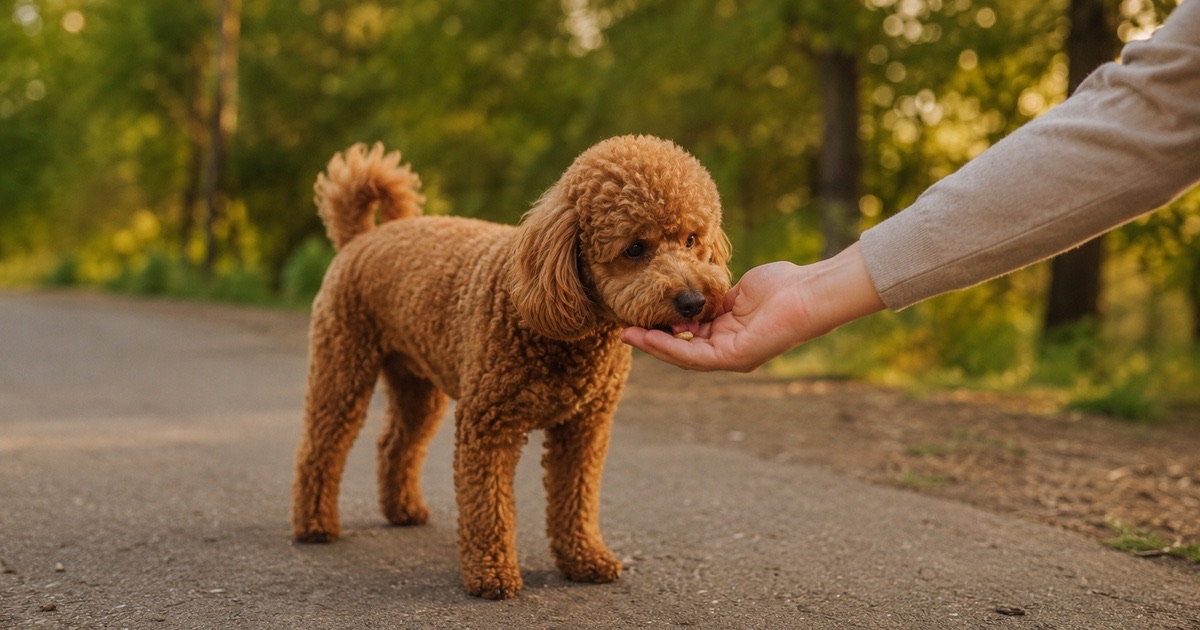
Choosing the treat
| Criterion | What | Why |
|---|---|---|
| Size | Half a pinky nail or less | Dozens of reps without the calories |
| Texture | Soft, fast-swallowing | No flow-breaking chew sessions |
| Smell | Aromatic | Focus-pulling power lives in the scent |
| Portability | No crumbling, no greasy hands | Field-ready for walk training |
Purpose-made training treats hit these specs, and scissoring big treats into fragments works just as well. I used to reward my dog Gureum with whole jerky strips (it means "cloud" in Korean), and only after watching the training reset itself during every 30-second chew did I learn the size lesson. Since going small, the same session fits several times the reps.
The one second: it's the whole game
A dog learns that whatever they were doing AT the moment of reward was the right answer. If the treat arrives three seconds after the sit, and they'd already stood, then STANDING got rewarded. Hence the rule: correct behavior to reward, under one second. To cut the fumbling time, stage treats in your hand or a waist pouch before training. And when your hands can't keep up, a marker word like "yes!" spoken AT the correct instant, treat following, bridges the gap: marker training.
Tiering: calories and motivation, one system
Use the premium treat for everything, and you overshoot the calories while erasing the specialness. Tier it. Easy indoor reviews: kibble set aside from the daily ration. New behaviors and walk training: mid-grade treats. And the life-or-death commands like recall ("come!"): that dog's once-in-a-lifetime treat. The kibble tier protects the daily calories, and the top tier's scarcity drives the recall rate up.
Training milestones, twice as sweet on video
The first successful sit, the first 10-second stay: perfect short-clip moments. Posts on kkeung keep their dates and collect likes from the neighborhood dogs, and the local feed's trick videos double as hints for your next training project.
Show the neighborhood dogs →Toward the treat-free day
Treats are training's ladder, not its crutch, and the goal is eventually removing the ladder. Once a behavior settles into the body, shift from every-time to sometimes (intermittent reward): the unpredictability actually SHARPENS focus. And always blend non-food rewards, praise, petting, play, alongside the treats. The ideal endpoint: your delighted reaction is itself the reward. One standing exception: recall. Keep the occasional jackpot treat alive for "come!" forever: a command that guards their life is worth paying for indefinitely.
When treats stop working
A dog ignoring the treat may need a higher tier, but more often the ENVIRONMENT outranks it: another dog nose-to-nose, or something scary nearby, and no treat on earth gets through. The answer there isn't upgrading the treat: it's adding distance and lowering the difficulty. Also, post-meal training runs on empty motivation: the slightly-peckish window before meals is the efficient slot. A day when treats don't work is almost never the dog's fault: it's the setup's.
Frequently asked questions
Won't training treats make them gain weight?
Isn't kibble too boring as a reward?
We're managing an allergy. What do we use for training?
They only obey when they SEE the treat. Is it a bribe now?
Using kibble for training: subtract it from meals?
This article is general information and does not replace a veterinary diagnosis. Talk to your vet about your dog's condition.