Are Poodles Really That Smart?
What the Intelligence Rankings Actually Measure
One of our walk friends is a Poodle named Choco: when his owner says shoes, Choco brings the shoes. My dog Gureum needs her name called three times to look up (it means "cloud" in Korean). So Poodles-are-smart seems true enough: but everyone means something different by smart. Let's start with what the famous ranking actually is.
Poodles ranking #2 in breed intelligence: true. But that ranking measured how many repetitions a new command takes, and how often the dog obeys the FIRST instruction: training responsiveness. Problem-solving and social savvy are different stories. And a smart dog learns the BAD things just as fast: smart and easy-to-raise are not the same claim.
What did the ranking measure?
The commonly cited ranking comes from a Canadian psychologist who surveyed hundreds of professional trainers. Two criteria: repetitions needed to learn a new command, and the first-command obedience rate. In other words, it measured how well obedience training goes: not a dog's overall mind.
| Rank | Breed | New command | First-command obedience |
|---|---|---|---|
| 1 | Border Collie | Under 5 reps | 95%+ |
| 2 | Poodle | Under 5 reps | 95%+ |
| 3 | German Shepherd | Under 5 reps | 95%+ |
| 4 | Golden Retriever | Under 5 reps | 95%+ |
| 5 | Doberman | Under 5 reps | 95%+ |
| For contrast | Shibas, Basenjis, Afghan Hounds | 80+ reps | 25% or less |
* The bottom of the list isn't dumb: those are independent breeds who rank their own judgment above human instructions.
Why do Poodles rank so high?
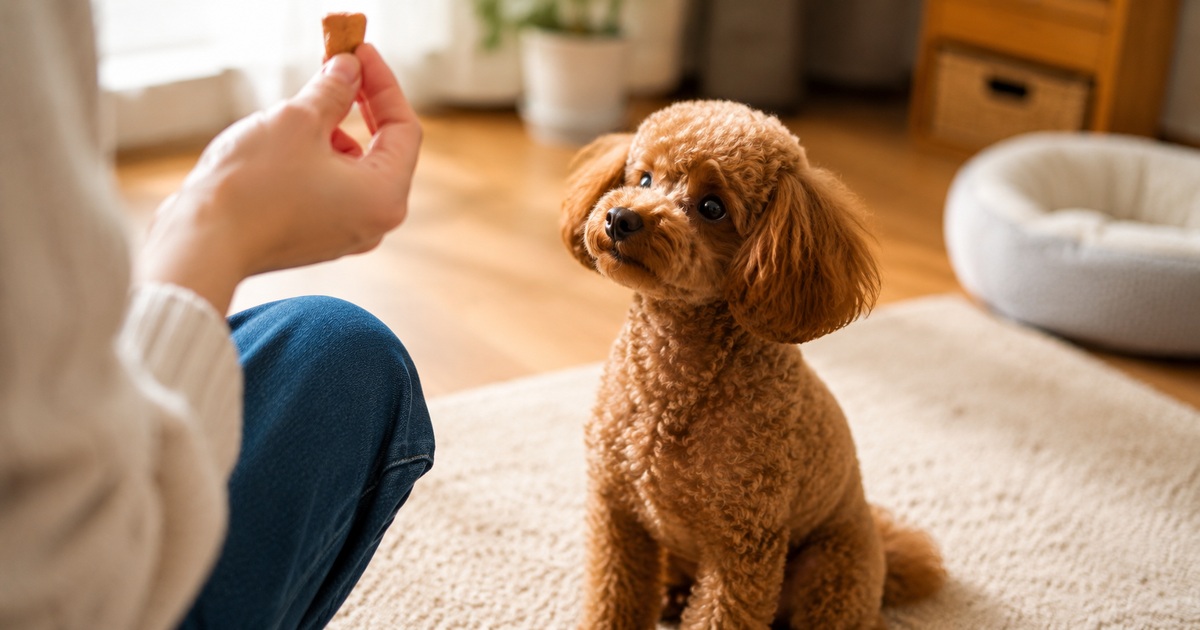
Poodles were bred as water retrievers: fetching downed birds from lakes. Instant response to human signals, tolerance for repetitive work, and joy in working WITH a person were selected for, generation after generation. That package reads directly as training responsiveness. Choco fetching shoes isn't raw intellect so much as a temperament that finds reading-what-the-human-wants genuinely fun.
Learned this on the job: the so-called bottom-ranked breeds: Shibas, Jindos: show off a different brilliance on walks. They dodge hazards on their own judgment and make decisions in strange situations without checking a human's face. It's a different SPECIES of smart.
Is a smart dog an easy dog?
- They learn the good fast: and the bad faster. Bark-produces-treats gets learned in one exposure.
- Bored, they invent their own entertainment: which may be couch demolition or trash-can archaeology.
- Under-stimulation breeds problem behaviors. Walks alone aren't enough: scent games and brain work are part of the spec.
- They test your consistency. Grant one exception and they file it precisely, forever.
So the Poodle is a genuinely good beginner breed: and also the breed that becomes the biggest headache if left to figure it out themselves. The smarter the dog, the more clarity of rules equals comfort.
New trick landed? Show it off
Training alone gets dull: training with an audience continues. Trick videos posted to kkeung keep their dates and collect likes and comments from the neighborhood dogs: and other households' tricks in the neighborhood feed make excellent hints for your next project.
Show the neighborhood dogs →If you're getting a Poodle
There are three sizes
Toy (under 9 lbs), Miniature (around 15 lbs), Standard (45+ lbs): similar personalities, wildly different exercise and grooming budgets. Toys and Miniatures are the city favorites: a Standard is a large dog in walk time and salon bills, and plan accordingly.
The coat is Bichon-grade work
Curly single coat: shed hair stays trapped instead of falling, so daily brushing and 6-8 week grooming are mandatory. The upside: Poodle haircut variety is half the fun of the breed.
Feed the brain
Walking isn't enough. Scent games, new tricks, puzzle toys: ten minutes of brain work daily, minimum. A Poodle tolerates a tired body far better than a bored mind.
Poodles are smart: the claim holds. But that smartness shines when an owner sets the direction, and misfires spectacularly when unattended. Choco's owner puts it best: it's like having a student who needs homework assigned daily. No better summary exists.
Frequently asked questions
Poodle or Bichon: which is smarter?
Are bottom-ranked breeds untrainable?
Does Poodle intelligence mean worse separation anxiety?
Are Poodle mixes (Maltipoos, Goldendoodles) smart too?
What tricks suit a Poodle?
This article is general information and does not replace a veterinary diagnosis. Talk to your vet about your dog's condition.