Homemade vs. Store-Bought Treats:
The Honest Comparison
"Homemade is always better; store treats are additive bricks." You've heard the binary somewhere. As someone who dries sweet potatoes most weekends, my honest verdict: it's half true. Knowing each side's strengths and traps, and combining them, is closer to the answer.
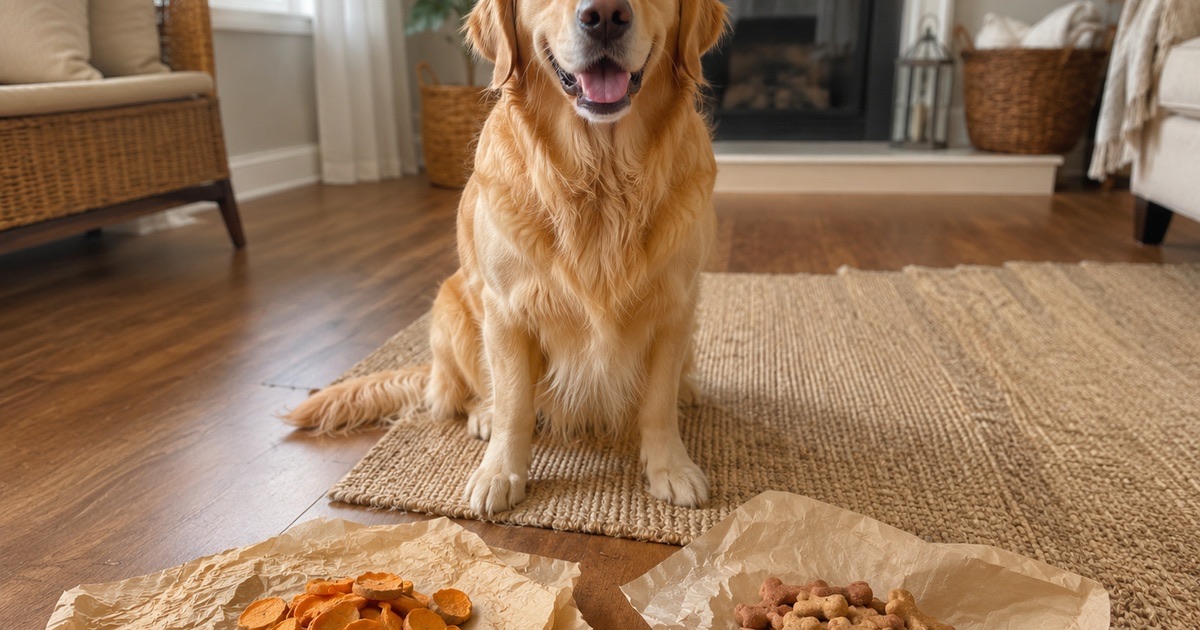
Homemade's strength is ingredient transparency; store-bought's is shelf life and consistency. Homemade skips the seasoning and additives but spoils fast: the refrigerate-3-to-4-days rule is law. Store-bought, for a label-literate buyer, offers good products used long and safely. The conclusion is the combination: vetted store treats day to day, homemade specials on unhurried weekends.
The head-to-head table
| Item | Homemade | Store-bought |
|---|---|---|
| Ingredient visibility | You choose: fully transparent | Rides on label-reading skill |
| Additives | None (you control it) | Varies widely by product |
| Storage | Fridge 3-4 days, freezer a month | Long unopened, sealed after opening |
| Nutritional balance | Single-ingredient skew risk | Engineered products hold balance |
| Cost and time | Cheap materials, real time | Time saved, price range varies |
| Hygiene risk | Spoilage on prep or storage slips | Managed supply chain is stable |
Homemade's traps: hygiene and skew
Homemade trouble starts not with the ingredients but after them. No additives means no preservation, so homemade jerky left out half a day is already in the danger zone: airtight, refrigerated, 3-4 days, frozen portions beyond that. Then the skew problem: dry only chicken breast daily because they love it, and you've built heavy single-protein exposure, the very backdrop allergies grow against. The more homemade you go, the more the ingredients should rotate. I once dried nothing but sweet potato for my dog Gureum for two straight months (it means "cloud" in Korean), and only learned at the clinic that THAT was skew.
Store-bought's trap: not reading the label
The problem isn't store treats: it's buying them without reading. Plenty of products carry clean, named ingredients and zero coloring: with a trained eye, store-bought is the sturdy choice for busy lives. Just memorize the avoid-list: rock-bottom-priced jerky with vague origins and ingredients, treats in suspiciously pretty colors (dye), and the opened bag left to go stale. That last one turns even a good product into a bad treat.
Homemade-treat day is a scene worth showing off
From the face waiting at the oven to the first bite, homemade-treat day photographs beautifully. Posts on kkeung keep their dates and collect likes from the neighborhood dogs, and the local feed serves up other households' treat brags too.
Show off the snack time →Recommended mixes by situation
A time-strapped working household sustains best on vetted store treats as the mainstay, homemade as the event. An allergy-managing household flips it: more homemade, because single-ingredient control is the whole point. On a diet: store low-calorie products plus homemade veggie treats (carrot, cucumber). For a senior: homemade shines, since softness is adjustable (less-dried sweet potato, well-steamed pumpkin). The ratio that fits YOUR household is the correct one.
Homemade hygiene in five lines
One: ingredients at human-grade freshness. Two: zero seasoning (salt, sugar, honey, all of it). Three: fully cooked or fully dried: half-moisture is where spoilage lives. Four: cooled, sealed, fridge 3-4 days, freezer past that. Five: any change in smell means tossing it, however it hurts. Hold those five lines and homemade becomes a genuinely great option. And the making itself turns out to be pretty good therapy for the human.
Frequently asked questions
A little honey or syrup in homemade treats: surely fine?
Any label entries to flat-out avoid in store treats?
Can I feed mostly homemade treats and cut back the food?
How do I thaw frozen homemade treats?
What's the buying standard for store treats?
This article is general information and does not replace a veterinary diagnosis. Talk to your vet about your dog's condition.