Can a Jindo Live in an Apartment?
An Honest Reality Check
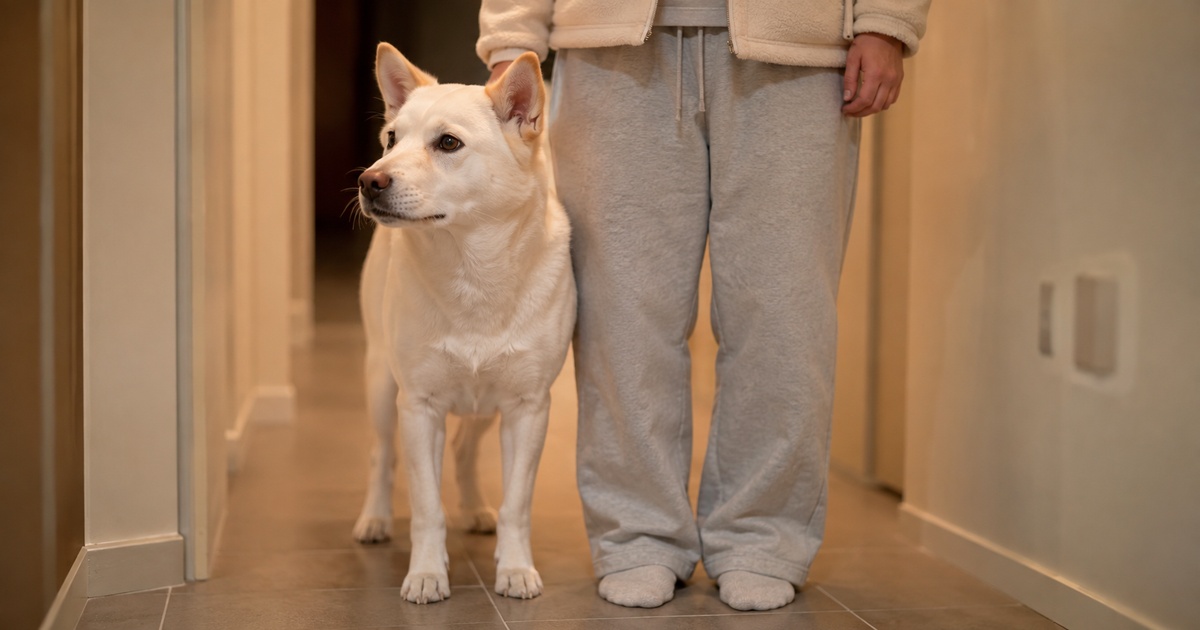
A Jindo named Baekgu lives in our building (a classic Korean name for a white dog). When we meet in the elevator, my dog Gureum bounces toward him (it means "cloud" in Korean): Baekgu presses against his owner's leg and tracks her with his eyes only. No bark, no approach. His owner has walked him at 5 a.m. daily for three years. Keeping a Jindo in an apartment, he says, is exactly that.
A Jindo CAN live in an apartment: with conditions attached. Thorough socialization at 3-4 months old (or a temperament-verified adult), an hour-plus of daily walking, experience handling intense wariness, and the attentiveness to read quiet tension instead of waiting for barking. Missing those conditions, both dog and owner suffer. As a first dog: not recommended.
What's the Jindo temperament?
The Jindo is Korea's native breed, developed on Jindo Island for hunting and home guarding. Deep loyalty to one person: strong wariness toward everyone and everything else. Independent-minded and self-directed: fastidious, which makes potty training quick: and a low barker. The trade-offs: a homing instinct strong enough that a dropped leash means a dog navigating back to an old address, and a prey drive that locks onto cats and small animals.
| Jindo | Notes | |
|---|---|---|
| Size | 18-22 in tall, 33-50 lbs | Medium |
| Temperament | Loyal, independent, intensely watchful, fastidious | One-person orientation |
| Barking | Low | Tension runs silent instead |
| Training | Hard | Independent: complies for reasons, not repetition |
| Exercise | High | An hour-plus daily |
| Coat | Double coat, heavy seasonal blows | |
| Lifespan | 12-15 years | |
| Common conditions | Relatively healthy: hips, skin allergies | A landrace breed: few genetic diseases |
Why is apartment life hard for a Jindo?
- The wariness: elevators and hallways deliver strangers and strange dogs on repeat. For an unsocialized Jindo that's daily stress: and accumulated stress can surface as aggression.
- The exercise: an hour of walking daily is the minimum: no yard to offload any of it.
- The independence: a beginner's clumsy commands get ignored. A Jindo cooperates when it feels respected: not before.
- The misread: the quiet looks easy: but a silently tense Jindo can go off in a moment. You have to know how to read the signals.
This I learned from Baekgu's owner: the core of Jindo apartment life is walking when nobody's out. 5 a.m. and 11 p.m. Fewer encounters is kinder to the Jindo and to the neighbors both. He's kept that schedule for three years.
If you're doing it anyway: the conditions
First: a dog whose 3-4 month socialization window was filled with people, dogs, sounds, and elevators wrapped in good experiences: an adult who missed that window has a set personality and adapts to apartment life with enormous difficulty. Second: prior dog experience in the household. Third: the daily hour of walking, actually available. Fourth: escape-proof equipment: a Jindo off-leash does not come back. A well-fitted escape-resistant harness, a strong leash, a microchip, and an ID tag are the baseline.
Three years of dawn walks: that record IS Jindo apartment life
Keeping a Jindo in an apartment means dawn walks sustained for years. Log walks in kkeung and the distance and time stack by date, a paw stamp on every walked day: the consistency preserves itself. A list with no missing stamps is what living with this breed looks like.
Start logging walks →If you've decided on a Jindo
Bet everything on socialization
At 3-4 months: one new person a day, one new dog a day, each wrapped in something good. The generosity built in that window lasts a lifetime. Miss it, and the adult may file every stranger under threat.
Train with respect
Jindos push back against force. Reasons work: comply-and-benefit: repetition doesn't. And don't chase a perfect recall: substitute a never-dropped leash instead.
The leash and harness
An escape-proof harness and a serious leash: non-negotiable. The Jindo homing instinct is strong enough to cover dozens of miles back to a former home. Microchip and ID tag: the baseline beneath everything.
The Jindo is a magnificent dog: loyal, healthy, immaculate. But that magnificence only comes out in an apartment when the owner is prepared to match it: like Baekgu's owner is. If a Jindo would be your first dog: honestly, raise a different breed first.
Frequently asked questions
Do Jindos really bond to just one person?
Are Jindos a restricted breed?
How much do Jindos bark?
How bad is Jindo shedding?
Why do Jindos keep showing up in shelters?
This article is general information and does not replace a veterinary diagnosis. Talk to your vet about your dog's condition.