Dachshund Personality and Traits:
The Long Back IS the Whole Story
Sausage, the Dachshund we meet on the walking trail, has twice my dog Gureum's torso on half her legs (Gureum's name means "cloud" in Korean). He used to chase her everywhere on those legs: until the day he appeared dragging his hind end. A disc. He recovered without surgery, thankfully: and his owner has since removed every couch from the house. Any honest Dachshund conversation starts with the back.
The Dachshund is a brave, stubborn, endlessly curious hunting dog: bred to enter badger dens, with the digging and barking instincts to match, and training that demands patience. And that long back carries an IVDD (disc disease) risk more than 10x other breeds': so weight control, a no-jumping rule, and stair avoidance are lifetime principles, not phases.
What's the Dachshund temperament?
Dachshunds were bred in Germany to enter badger dens and hunt. The short legs and long body are tunnel engineering: and a dog that fought badgers underground, alone, comes out fearless beyond its size and stubborn to match. The scent drive runs strong: nose glued to the ground on walks: and digging and burying rank among life's great pleasures. With their person: deep affection and real comedy. With strangers: wary, and vocal about it.
| Dachshund | Notes | |
|---|---|---|
| Size | Miniature 9-11 lbs, Standard 16-32 lbs | Miniatures dominate city living |
| Temperament | Brave, stubborn, curious, playful | Hunting-dog wiring |
| Barking | On the high side | A voice bigger than the body |
| Training | On the hard side | Stubbornness and independence |
| Exercise | Moderate | Two 30-minute walks: jumping prohibited |
| Coat | Smooth, long, and wire varieties | Smooth is most common |
| Lifespan | 12-16 years | |
| Common conditions | IVDD (disc disease), obesity, dental disease, kneecaps |
Why is the Dachshund back so fragile?
The short legs come from a cartilage-development difference: and the same difference calcifies the spinal discs early. A hardened disc ruptures easily under impact: a rupture presses the spinal cord: hind-leg paralysis follows. Roughly one in four Dachshunds faces a disc episode in their lifetime, most often between ages 3 and 7.
This I learned from Sausage's owner: eighty percent of prevention is WEIGHT. Fat on a long back sags the spine and loads the discs. A ribs-palpable body, maintained for life, out-prevents any supplement on the market.
The back-protection rules
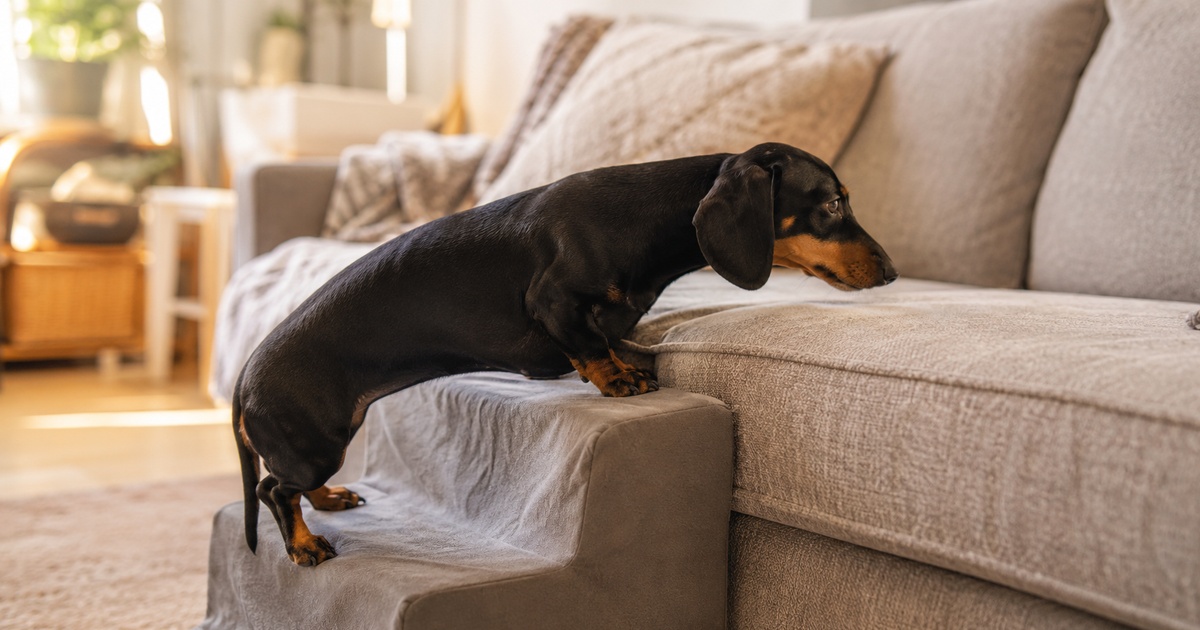
- No jumping: couch, bed, and car happen via ramp or arms. One leap down is all a disc needs.
- Avoid stairs: carry them. Up and down both jolt the spine.
- Carry correctly: one hand under the chest, one under the rear, back held level. Never lift by the front legs alone.
- Weight: ribs palpable, waist visible from above. Treats stay inside 10% of daily calories.
- Non-slip floors: mats over the hardwood. A skid twists the spine.
- Harness, always: leash pressure on a collar jolts the neck and spine.
Half of back care is weight: half of weight is walking
Dachshund back management compresses into two moves: block the jumps, grow the walks. Log walks in kkeung and the distance and time stack by date: whether the two-a-day 30-minute quota got filled is checkable every evening. The paw-stamp list is back insurance.
Start logging walks →Disc signals, and what to do
Early signs
A hunched back while walking: a yelp when lifted: refusing stairs: hind legs dragging. Sausage's first sign was declining the couch one morning. That day IS the vet day. Watch-and-wait until paralysis arrives, and the recovery odds drop hard.
Treatment
Mild cases recover on medication plus 4-6 weeks of strict crate rest. Progressing paralysis means surgery: $3,000-8,000: often with rehab therapy following.
Preventing the repeat
One episode raises the odds of another. The no-jump rule and the weight discipline continue for life after recovery. Sausage's household swapped in a lower couch and carpeted the place in ramps and mats.
The Dachshund's long body is the entire charm and the entire weakness in one package. Know the weakness, remodel the house around it, and fifteen healthy years follow. Sausage now takes the STEPS onto the couch: and looks down at Gureum from it.
Frequently asked questions
Can Dachshunds live in apartments?
Is there preventive surgery for Dachshund disc disease?
My Dachshund keeps digging. Should I stop it?
Why are Dachshunds so stubborn?
What's the right Dachshund weight?
This article is general information and does not replace a veterinary diagnosis. Talk to your vet about your dog's condition.