Probiotics for Dogs: Do They Work?
An Honest Rundown
Good for the gut, they say, so skipping it feels like a loss, and giving it shows nothing you can point to. No supplement is murkier than probiotics. The honest bottom line: probiotics are no cure-all, but chosen for the right situations, they're a genuinely useful tool. Knowing which situations is the whole game.
The classic help cases: after antibiotic treatment, a sensitive gut with recurring soft stool, and periods of upheaval (new adoption, a move). Conversely, a healthy dog with good stool and easy digestion may show no perceptible change. When choosing: dog-specific, with named strains and a guaranteed CFU count. Feed 4-6 weeks, judge by the stool, then decide whether to continue.
Helps vs. hardly
| Verdict | Situation | Note |
|---|---|---|
| Helps | During, after antibiotics | Rebalancing assist: coordinate with your vet |
| Helps | Stress-related soft stool | A move, early adoption days, travel |
| Helps | Food transitions | Gut adaptation assist |
| Watch and see | Chronic soft stool | Rule out disease first; then as support |
| Hardly | Healthy adult, good stool | Perceptible effect may be minimal |
One caution up front: probiotics are not diarrhea medicine. Days-long diarrhea, blood, or vomiting alongside is not a ride-it-out-with-probiotics situation: it's a vet situation. Their place is management and support, never treatment. My dog Gureum gets a 2-week course only when her stool runs soft after antibiotics (it means "cloud" in Korean); when I tried it day-to-day, I honestly couldn't tell the difference.
Can't they share my probiotics?
A frequent question, and the answer is no. Human and canine gut environments and core flora differ, so products built on strains studied in dogs are the fit. Human products can also carry dangerous additives like xylitol or heavy flavoring. Same word, "probiotics"; different contents entirely.
The 3-point product check
First: named strains. Not vague "contains probiotics" but the specific strains, spelled out: that's the trustworthy label. Second: guaranteed count. The better products state the CFU count guaranteed alive through the expiration date, not just at manufacture. Third: storage terms. Bacteria die in heat, so ignore the storage instructions and even a great product goes inert. Cool storage after opening, and refrigerate when the label says so.
There's exactly one effectiveness test: the stool
Once probiotics start, stool is the judging panel. Post stool photos to kkeung and each post keeps its date, so before-start and two-weeks-in sit side by side. Whether it works stops being a memory and becomes a photo record.
Save a photo of today →Feeding technique and the classic mistakes
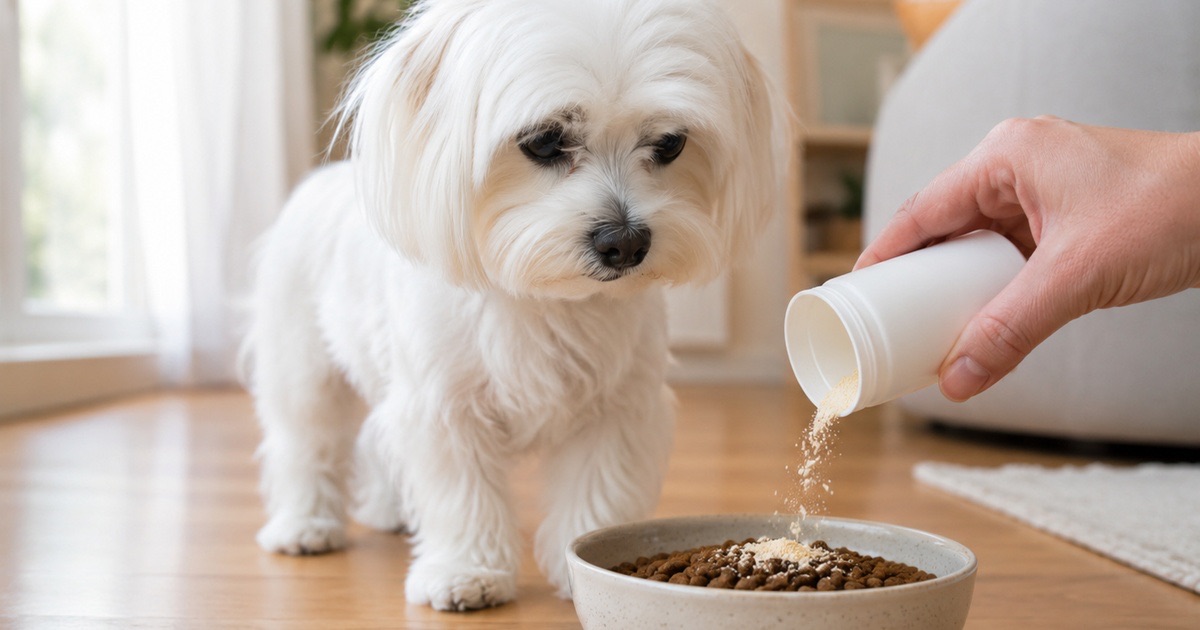
Powder mixes into food, but mix it into hot water or freshly warmed food and the bacteria die: mix in once it's cooled. Given with antibiotics, you'll usually be told to separate the timing: confirm at the prescription. And the most common mistake of all: two days in, "no effect," discontinued. Gut changes run on a scale of weeks, so a fair evaluation needs at least a month of consistency. The flip side holds too: months in with zero change means this product and your dog weren't meant to be. Clear it out, no regrets.
What to check before probiotics
If soft stool is the worry, audit these before reaching for a supplement: treats running over the limit, a recent food change, scavenging on walks, any dairy or greasy handouts. Any one of those hits, and the problem often resolves with no probiotics at all. Gut health's foundation is regular meals, measured treats, and enough exercise. Probiotics are a role player working on top of those fundamentals: worth remembering.
Frequently asked questions
Can't I just give yogurt instead?
The probiotic made the stool SOFTER.
Once started, is it forever?
What are prebiotics and postbiotics then?
When's the best time to give probiotics?
This article is general information and does not replace a veterinary diagnosis. Talk to your vet about your dog's condition.